
In advance of the ensemble’s new concert, MIT professor and Gamelan Galak Tika co-founder Evan Ziporyn reflects on the group’s more than thirty year history
In 1979, Evan Ziporyn was filing vinyl at Festoon’s, a part-time job while studying music as an undergraduate at Yale, when he first heard a field recording of a gamelan over the record store’s speakers. It was an intricate, fractal orchestral music, springing from the island of Bali, intensely rhythmic yet aerated by high skittering iridescent melodies that was unlike anything he had heard before. Metallophones, gongs, and bronze kettles burst forth, overlaid with drums and small cymbals. “It was Miles Davis, it was Coltrane, it was Bartok, it was Stravinsky, it was Weather Report and Herbie Hancock–basically everything I liked in music,” he says, “the first ten seconds of the track was all it took.”
A few nights later, Ziporyn was sitting in a booth at Naples Pizza, where the music students would hang out, and overheard a music professor say that someone named Michael Tenzer had acquired a gamelan. Ziporyn leaned over the booth and asked for that person’s telephone number. He thought the owner of the gamelan might be living somewhere in New Haven, but the number had a California area code. He called, and by the summer found himself in Berkeley, where Tenzer was just beginning to form his Sekar Jaya ensemble, part of a larger gamelan renaissance in the United States beginning to take shape. By the millennium, about 60% of gamelan ensembles in North America would be housed within universities. After graduating college, Ziporyn boarded a plane to Bali.
The origins of gamelan in Western music are commonly traced back to Claude Debussy, who was first awed by the instrument at the 1889 Paris Exhibition–leading the way for other European composers such as Maurice Ravel and Béla Bartók. The composer Colin McPhee lived for nearly seven years in a village on the Ayung River valley in the 1930s, his extensive documentation of the crystalline music he once described as “aerial and purely sensuous” became the gamelan’s definitive source for foreigners. His 1946 memoir House in Bali was the inspiration for Ziporyn’s opera of the same name, which explores the beautiful and at times dissonant work of cultural translation. But if earlier generations of composers saw the gamelan as extractable exotica, or were tacitly encouraged by Western institutions to abandon it, Ziporyn has woven together these disparate musical strands throughout his entire long career.
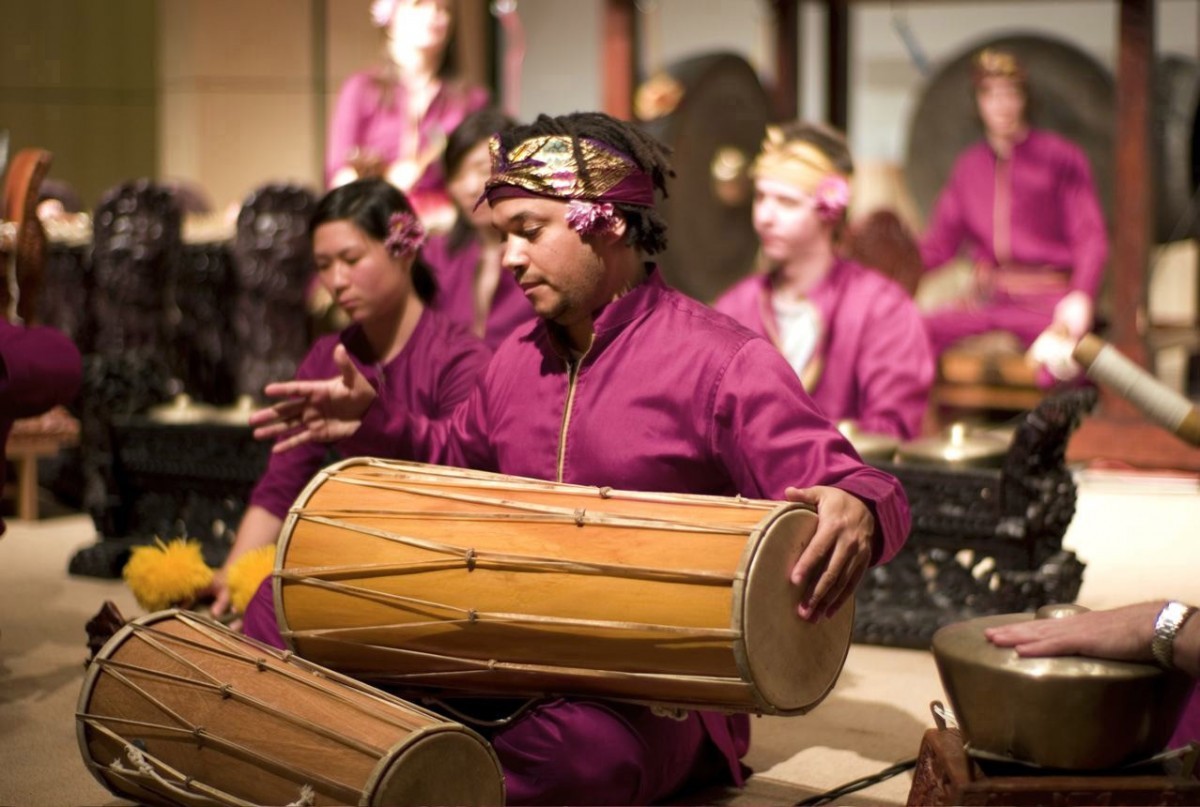
In 1981, Ziporyn studied with Madé Lebah, the same Balinese musician who had worked as a kind of musical doula for Colin McPhee fifty years earlier, connecting the ethnomusicologist to the island’s greatest players. Ziporyn had never been to Asia before, his travels never extending beyond school trips or hitchhiking around California. “Suddenly I was in Bali by myself, and went into this state of extreme culture shock when I realized how huge this was,” he remembers, “It wasn’t studying one little thing, but an entire culture, which was going to require a lot more than just learning how to play a few instruments.”
What Ziporyn found in Bali, in the Indonesian archipelago stretched across the Indian ocean, would shape not only his life, but generations of students at MIT, where he became a professor in 1990. When he first started, Ziporyn wanted to form a gamelan ensemble open to anyone in greater Boston. At the time, the music department was firmly oriented toward Western music. After stints in a damp basement—where the loud percussion could be heard from Hayden Library—and a storage closet in Kresge Auditorium, the group was finally gifted what became the Endicott World Music Room. It was a small, beloved, and heavily sound-proofed space, nearly overspilling with the sheer number of groups that occupied it, below what was then the MIT Museum, a former factory on the outer edges of campus that bled into the hustle and bustle of Central Square. The group shared a floor with the hackers and guerilla engineers of the MIT Model Railroad Club and MIT Electronic Research Society (MITERS), finding camaraderie with scrappy eccentrics whose proclivities bent the status-quo. The ensemble borrowed tools from MITERS to tune and repair their instruments, and played the Tetris game built into the Railroad Club’s miniature model of the Green Building.
Gamelan Galak Tika became a haven for experimental musicians whose interests didn’t fit neatly into any prescribed categories. “If you were looking to stretch yourself musically, or you felt like a musical outsider, this was a place where you would go,” says Ziporyn, “and there was this feeling of people finding each other.” He co-founded the group with Desak Made Suarti Laksmi, one of the first Balinese female composers, and traditional dancer Nyoman Catra. It commissioned works from both legendary Balinese and American composers like Dewa Alit and Terry Riley, but also from its own members. The spirit was participatory and egalitarian. “If you want to compose for the group, you can compose for the group—we just made that a policy,” says Ziporyn. Over time, this open-ended ethos, in classic MIT fashion, led the group to build an electronic gamelan and collaborate with a group of robots. The group would go on to collaborate with Kronos Quartet and Wilco composer Glenn Kotche, and perform in gilded venues like Lincoln Center and Carnegie Hall.
Part of the beauty of the gamelan was that anyone could learn it. Gamelan is a form of music without a system of written notation, which means that anyone can pick up the instrument without much formal training. “There’s parts for people who have a lot of technique, and there’s parts for people who have very little technique,” says Ziporyn. The key is in the careful attunement to the group, as one learns one’s own note from the ripple of the ones preceding. As players sit side by side in rows, the music is transmitted through intimate, hand-to-hand exchange. “It’s a communal thing, but a highly intricate one,” says Ziporyn, “You learn through a kind of physical mimesis, as if you’re literally handing the music off through the instrument and the motion.”
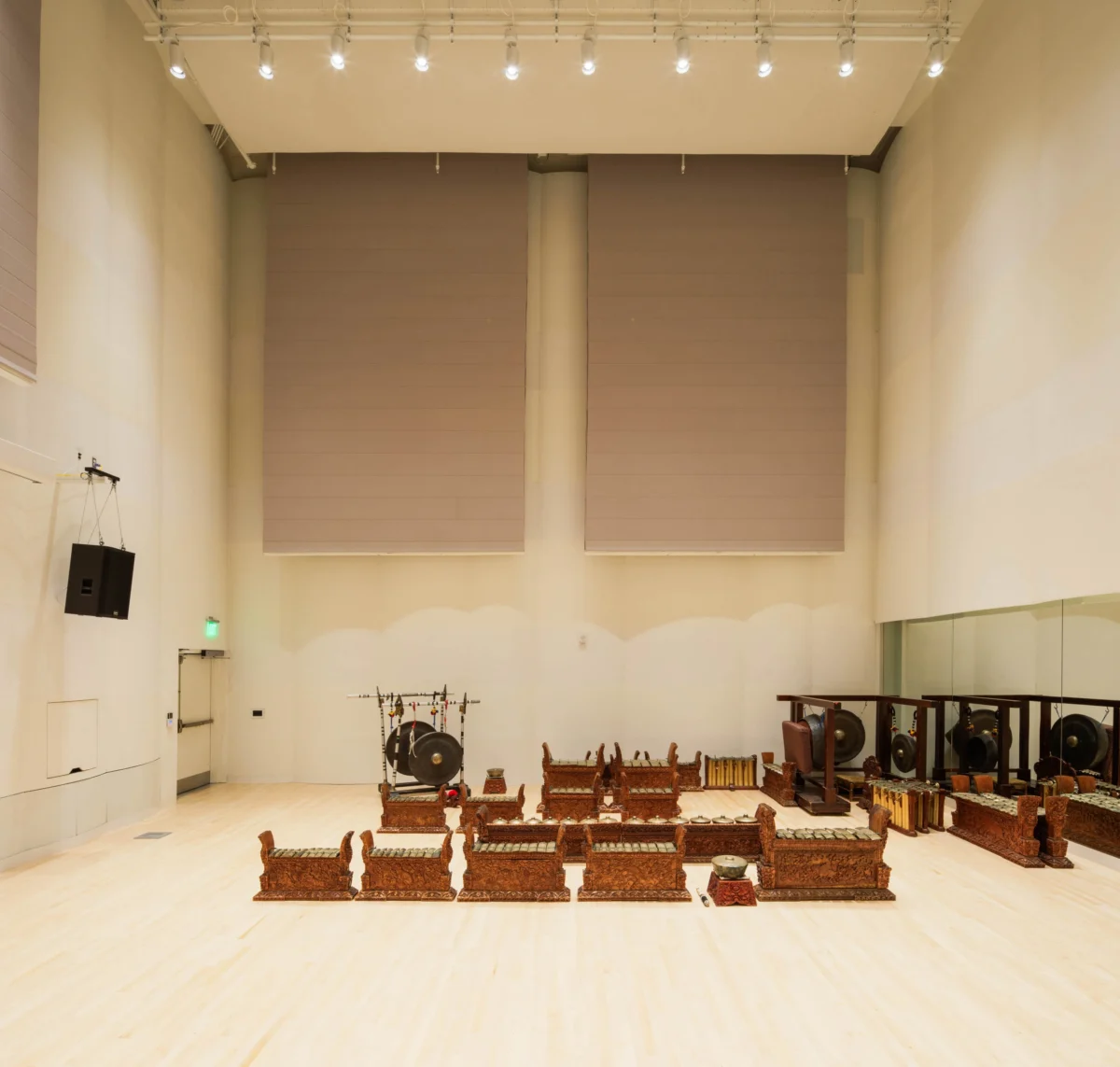
Last year, with the construction of the Edward and Joyce Linde Music Building, the ensemble finally upgraded to an airy, spacious rehearsal space across from Thomas Tull Hall whose centrality reflects the group’s now much bigger institutional footprint. Since the gamelan’s founding, students began to earn course credits for playing in the ensemble, and Ziporyn started teaching classes on the music of Indonesia and other parts of the world. The music department expanded to include ethnomusicologists specializing in South Asian, Japanese, and African music. Gamelan Galak Tika has performed alongside MIT’s symphony orchestra, with the Boston Pops, and at former MIT president Susan Hockfield’s inauguration. “Now there’s a lot more opportunities at MIT for people to play all sorts of music,” says Ziporyn. From Senegalese drumming to electronic dance music, the music on campus reflects the Institute’s global community.
The group’s debut in the new concert hall in May 2025 seemed an opportunity to gather the ensemble’s members, dispersed across continents, from the last few decades. Ziporyn created Galak Tika so that others could have the same life‑changing experience he had experienced in Bali; thirty or so years later, the reunion proved that to be true. He thought only a few would respond, but his call drew musicians from as far as California and Berlin to play together again at MIT. “What was really overwhelming was walking into this rehearsal room and seeing thirty years of my life before me,” he says, “Every rehearsal was like a family reunion,” he recalls. The youngest member was eighteen; the oldest seventy-eight.
Now, the intergenerational, cross-cultural group is reuniting again in MIT’s Thomas Tull Hall for “Gamelan Showdown,” a battle of the bands-style concert with Gamelan Yowana Sari, a sister ensemble from Queens College. Celebrating Gamelan Yowana Sari’s debut self-titled album on Cantaloupe Music with a Balinese mebarung—which translates to “melody competition”—the concert blends the ancient and the electrified, traditional Balinese gamelan with contemporary Western elements like the electric guitar and bass. The concert features Queens faculty Kyle Miller’s “Stones are the Flowers,” and the world premiere of “Guirlandes” by French composer Theo Merigeau.
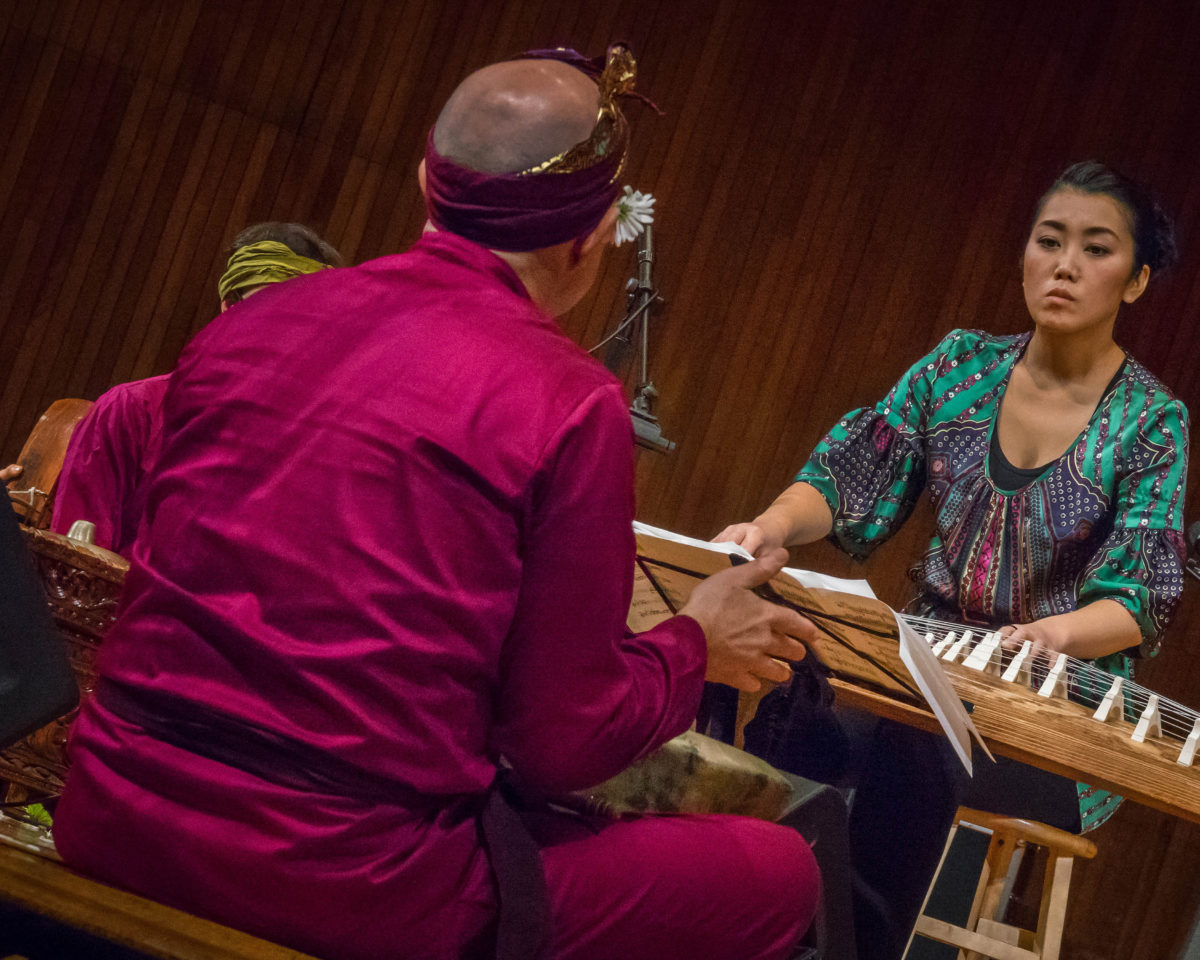
The ensembles will also perform a retrospective of Ziporyn’s compositions—a tonally distinct journey through the decades—including the dense, frantic “Amok!,” the first piece he composed for the gamelan and sampler technology in the mid-nineties, the meditative 2004 “Aradhana” with world-renowned koto and shamisen soloist Sumie Kaneko, and the euphoric new “aERIFoRm kITE” that was recently recorded by Gamelan Yowana Sari in Bali. For Ziporyn, “aERIFoRm kITE” marks a shift from his compositions from the early 90s. While those pieces reveled in the idea of cultural collision, the divergences in timbre and tuning in different musical traditions, his newer work finds what he calls “the hidden commonalities” between cultures.
The name Gamelan Galak Tika in classical Javanese-Sanskrit means “fierce togetherness.’ For Ziporyn, to play with old friends is a homecoming. From the vantage of three decades, he has seen an ensemble dedicated to what was once considered a little-known ensemble in the West weave itself into the very fabric of the institution, changing what it means to play music at MIT. For a long time, Ziporyn says, he wanted to be a village musician: the traditional bards or griots whose song, keyed to the cycles of collective life, formed the heartbeat of a community. “This is my village,” he says, “the gamelan is my village, and I suppose MIT is my village too.”
Written by Anya Ventura
Editorial direction by Leah Talatinian
Event details:
GAMELAN SHOWDOWN: A Balinese Battles of the Bands
March 21 / 3:30–5:30pm
Thomas Tull Concert Hall (W18-1102)
201 Amherst St, Cambridge MA
Get tickets
Gamelan Galak Tika, 2026
Evan Ziporyn, Music Director
Raymond Brookman ’26
Mark David Buckles
Ramon Castillo
John Cho
Ian Coss
Eran Egozy ’95 G
Emily Gunawan
Noam Hassenfeld
Chris Kline ’99 G
Sean Mannion
Ryan Meyer
Stephanie Mitchell
Kep Peters
Ponnapa Prakkamakul
Alex Rigopulos ’92, ’94 G
Sachi Sato
Dan Schmidt ’91
Nick Smucker
Christine Southworth ’02
Mark Stewart
Emma Terrell
Erin Thomas ’95
Leo Ziporyn