
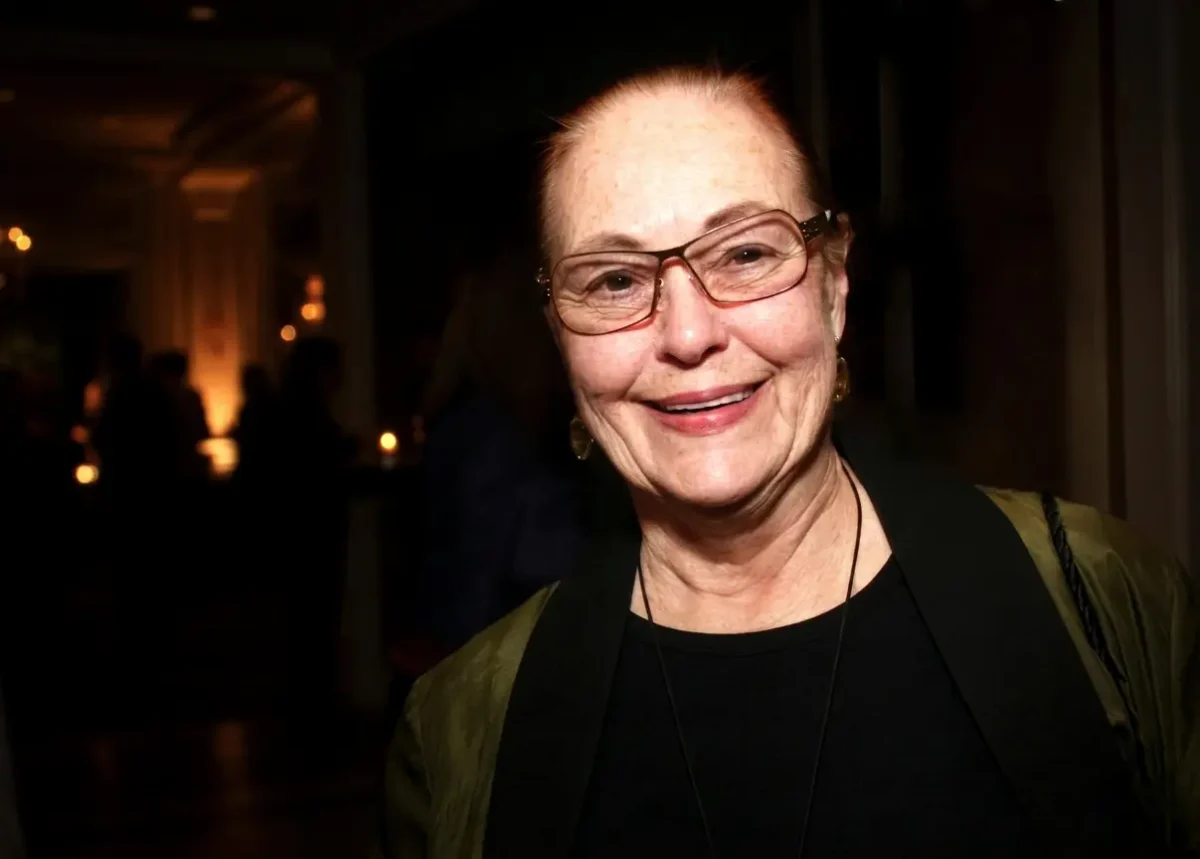
The MIT arts community mourns the passing of Brit d’Arbeloff, Corporation Life Member Emerita and one of the most dedicated champions for the arts at MIT, who died on May 8, 2026, at the age of 91. For nearly three decades, d’Arbeloff shaped the growth of the arts at the Institute through her leadership of the Council for the Arts; her philanthropy across the MIT Museum, the List Visual Arts Center, and the Edward and Joyce Linde Music Building; and her deep personal engagement with artistic life on campus.
A pioneer throughout her life and a vocal advocate for women in engineering and science, d’Arbeloff was the first woman to earn a mechanical engineering degree from Stanford University, graduating first in her class, and went on to earn her SM in mechanical engineering at MIT in 1961. When she reengaged with the Institute decades later—after raising four children, building a career as a programmer and systems analyst, and running a women’s clothing boutique in Boston—she brought a conviction that no form of creative or intellectual contribution should be treated as secondary. With her late husband, Alexander d’Arbeloff ’49, who chaired the MIT Corporation from 1997 to 2003, she established the d’Arbeloff Fund for Excellence in Education to support innovations in teaching and undergraduate life. The couple also funded the Brit and Alex d’Arbeloff Laboratory for Information Systems and Technology in the Department of Mechanical Engineering. She served on the MIT Corporation and its Development Committee, on visiting committees spanning aeronautics to humanities, and on the board of the Whitehead Institute for Biomedical Research, where she established the Brit Jepson d’Arbeloff Center on Women’s Health. Her philanthropy and volunteer leadership extended well beyond MIT to the Isabella Stewart Gardner Museum, the Museum of Science, and Rogerson Communities, among other organizations.
It was in the arts, however, that d’Arbeloff found what she described as the human side of the campus. When Alan Brody, then associate provost for the arts, recruited her to the Council for the Arts at MIT (CAMIT), she admitted to some initial skepticism about the scope of arts programming at a technical university. Fifteen years as CAMIT chair dispelled it entirely. Under her leadership from 1997 to 2012, the council expanded its support for student arts initiatives, faculty projects, and public programming across campus. She came to believe that the arts belonged at the center of MIT’s educational mission—parallel to science and technology for its power to nurture instincts for creativity and experimentation. In 2012, she received the Catherine N. Stratton Medal in the Arts, the council’s highest honor for leadership, advocacy, and philanthropy in the arts at MIT.
D’Arbeloff’s giving to the arts was broad and sustained. At the MIT Museum, she and Alex played a transformative role for decades, providing leadership-level annual support and funding educational initiatives that expanded public engagement with the Institute’s work. When the museum planned the opening of its new building in Kendall Square, d’Arbeloff provided a major gift. The Brit J. (1961) and Alex (1949) d’Arbeloff Gallery at the MIT Museum, which opened in 2022, houses Essential MIT, a signature exhibition that welcomes visitors to explore the Institute’s history and impact across science, technology, design, and the arts.
At the List Visual Arts Center, d’Arbeloff was a dedicated supporter for decades, providing annual funding for artistic programming and attending exhibition openings with an enthusiasm that staff and curators remember fondly. She served on the Advisory Board from 2013 to 2019 and was an active participant in the Director’s Circle. In 2008, she helped establish the List Center’s first endowed conservation fund, which continues to support the preservation of the List’s permanent collection.
D’Arbeloff’s support of the Edward and Joyce Linde Music Building reflected years of close involvement with the project, and in 2019 she made a significant gift toward its construction. The main entrance bears the name d’Arbeloff Family Plaza. Though she was unable to attend the building’s dedication in December 2024, she and her family visited together in September 2025 to see the completed space—a building that, like so much of d’Arbeloff’s philanthropy, was designed to bring people together around shared creative experiences.
Through her support of the Central Square Theater, she established the Brit d’Arbeloff Women in Science program within the Catalyst Collaborative@MIT, enabling the theater to dedicate one production each season to highlighting the contributions of women in STEM. Over the past decade, the program has supported twelve full-length plays and, in 2021, a monthlong virtual festival of women in science plays.
Among MIT’s major donors, d’Arbeloff was singular in the consistency of her presence. She could be found in the front row of arts events on campus—large and small, across disciplines—fully engaged with whatever was being performed, exhibited, or discussed. Her intellect was matched by a wit that colleagues describe as sharp and self-deprecating; her generosity by a genuine curiosity about the work itself. Asked what kept drawing her back to the Institute, her answer was simple: “What’s not to like about spending your time with a lot of really smart people?”
Keeril Makan, vice provost for the arts and the Michael (1949) and Sonja Koerner Music Composition Professor, reflected on her legacy: “Brit d’Arbeloff was a champion of the arts at MIT whose impact on the lives of students and the entire MIT community is visible in the spaces named for her and in the hundreds of artistic pursuits she made possible in all corners of the Institute. We will honor her memory throughout our campus as we continue to come together and take part in the artistic experiences she wanted us all to share at MIT for years to come.”
The MIT arts community extends its deepest condolences to d’Arbeloff’s children—Kate, Eric, Matt, and Alexandra—and to her seven grandchildren. In lieu of flowers, the family asks that donations be made to the Brit Jepson d’Arbeloff Center on Women’s Health at the Whitehead Institute for Biomedical Research or to Rogerson Communities.
Written by Tim Lemp
Editorial direction by Leah Talatinian