
Student Art in the Vice Chancellor’s Office

Vice Chancellor for Graduate and Undergraduate Education David Darmofal (also the Jerome B. Wiesner Professor) supports a rotating exhibition of student art in his office in MIT Building 7. The exhibiting artists are selected from recipients of art grants and awards and applicants to the Wiesner Student Art Gallery. Opportunities to participate in these programs are available to current students from all departments at MIT and are administered by the Office of the Arts.

The exhibition in the Vice Chancellor’s office can be viewed by appointment. For information about visiting or exhibiting in the space, please contact Wiesner Student Art Gallery Curator Sarah Hirzel at shirzel@mit.edu.

The Wiesner Student Art Gallery on the second floor of the MIT Stratton Student Center hosts rotating exhibitions of student art and design and is open to the public during Student Center hours, seven days a week, 9am to 9pm.

Current Exhibitors

Jessica Stringham

MAS ’26, MIT Media Lab Future Sketches

Hand, Frame (nos. 3, 4, 5, and 6)

Ink on paper, 2025

“Visualizing the bugs in loop removal,
materialized using a pen plotter.”

Jessica Stringham is a computational artist who performs under the name this.xor.that. Stringham creates live visuals using Murrelet, an open-source live coding framework they began building in 2022. They have performed in venues across the United States, Spain, France, South Korea, and China. Stringham also created Retina, a computational wallpaper inspired by anatomical illustrations of the eye, recently on view at the MIT Museum Studio. Their master’s thesis explores what observation-based practices—shaped by a love of birdwatching—can teach computational artists. They also work with pen plotting and generative coding to create drawings such as Hand, Frame. Stringham was recognized with the 2026 Harold and Arlene Schnitzer Award in the Visual Arts.

More at the artist’s website

Rebecca Lin

EECS PhD candidate, advised by Erik Demaine in CSAIL

Disintegrating (State of Mind)

Laser engraving on printmaking paper, 2025

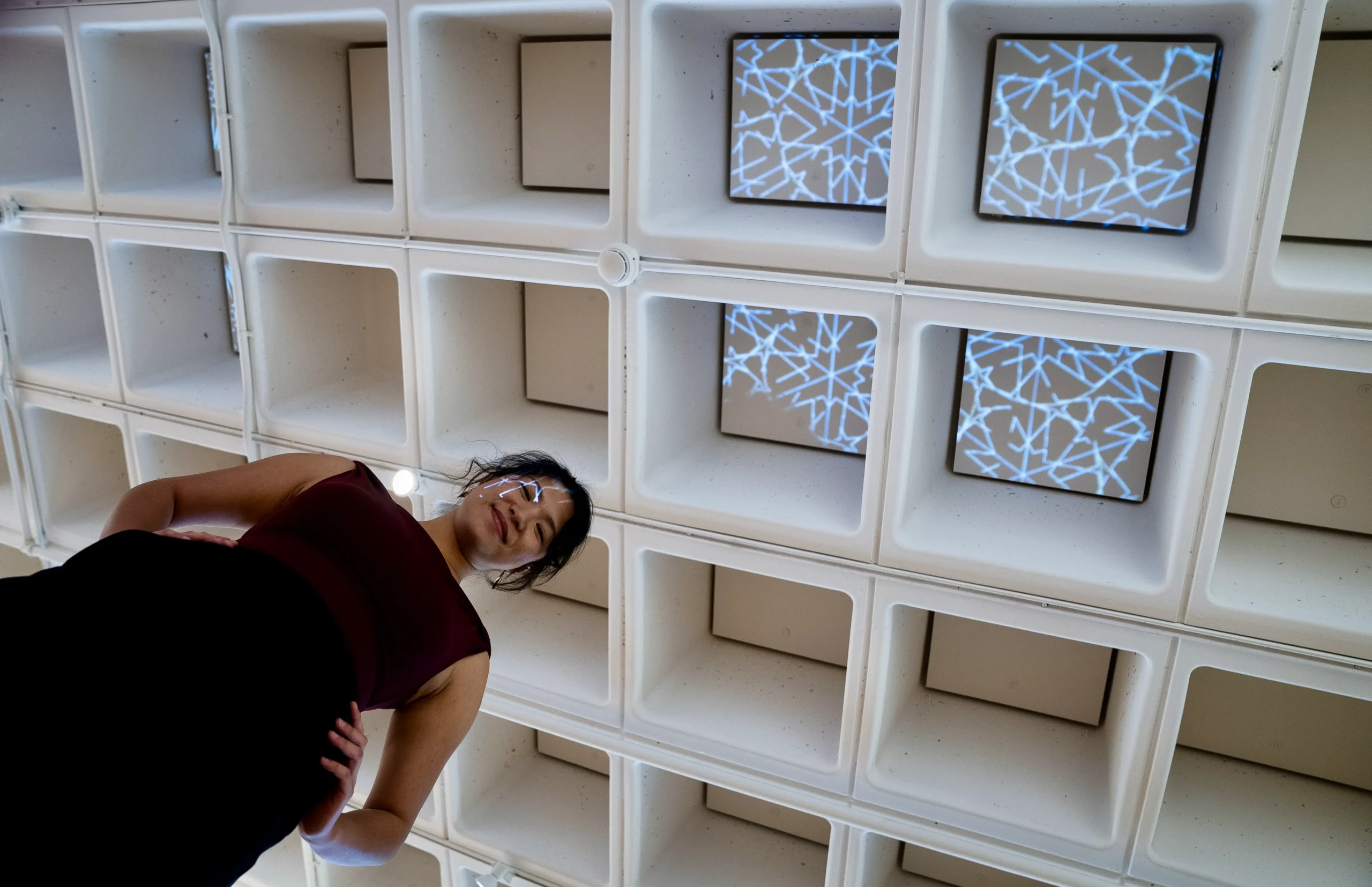
Disintegrating (State of Mind) translates mathematical abstraction into pattern and texture. Its constellation was designed using an encoding–decoding framework: first encoded as a mathematical graph, then realized geometrically through circle packing and adaptations of classical compass-and-straightedge constructions. The constellation was then manually disassembled, disrupting the symmetries of classical Islamic geometric ornament while leaving the resulting form at once ordered and unraveling. Laser-engraved into printmaking paper, the final pattern makes abstract structure tactile and felt.

Lin is quoted in an article about her exhibition in the MIT Wiesner Student Art Gallery: “I develop mathematical abstractions and computational tools that facilitate new approaches to art, design, and fabrication,” she explains. “By transforming abstract concepts into visual and material systems—mathematical graphs into geometric patterns, which can then be articulated through code and craft—it’s possible to expand our vocabularies for reasoning and making.”
More at the artist’s website

Courtney “Coco” Allred

SMACT ’26, Art, Culture, and Technology

Untitled Monotype (Battery Composition #4) (south wall)
Untitled Monotype (Battery Composition #1, #2, #3)
(west wall)

Monoprint on paper, 2026

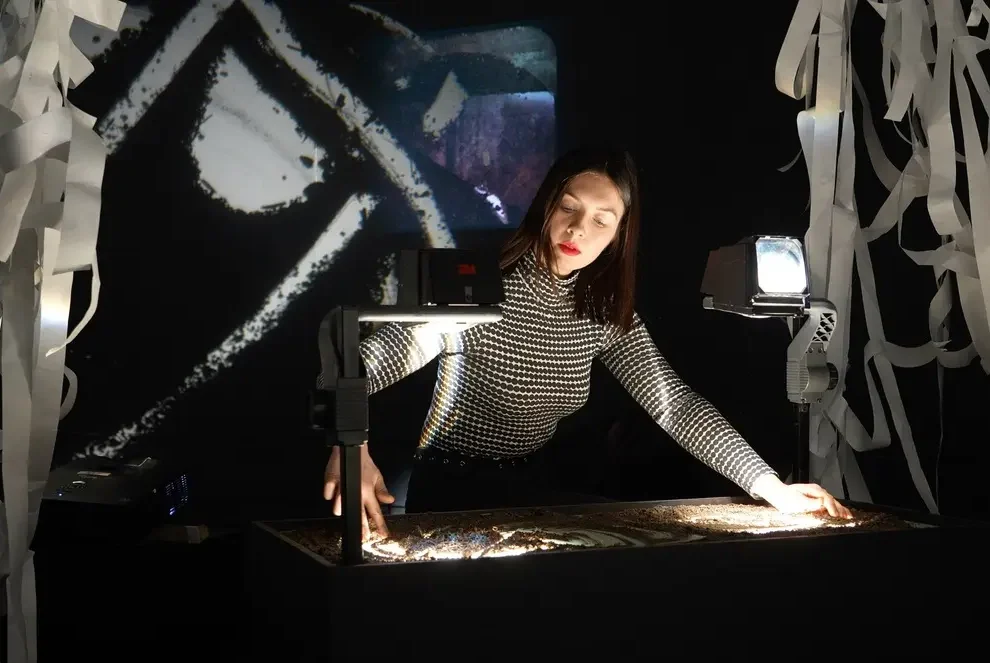
Untitled Monotype (Battery Compositions) is a collection of monograph prints that use repeating shapes to create a range of compositional outcomes: positive forms become negative space, and the shape of a still life is cut through with pattern. The shapes in these prints were observed in the decommissioned military batteries that dot the coastlines of the United States and their surrounding landscapes. Direct observation and transformation of shape becomes an aesthetic strategy within a larger inquiry: How can we “talk back” to architecture, engage our agency as citizens, and ephemerally mark our presence?

Coco Allred is artist-educator who designs environments that foster collective art making and learning. Coco Allred’s practice explores the intersections of public space, aesthetics, and experimental pedagogy. With a background in sculpture, printmaking, interdisciplinary programming, and intergenerational teaching, Allred inverts ideas of authorship in her interactive installations. Activities usually performed alone—drawing, printing, weaving—are instead performed collaboratively. Her participatory textile project You Are Your Line was featured at the 2025 Kaunas Biennale, emerging from an embroidery workshop she directed in Lithuania during a MISTI residency. In Primacy of Shape, a 2025 exhibition at the MIT Wiesner Student Art Gallery, she introduced over 100 people to printmaking, culminating in a collaborative artist book. Allred was recognized with the 2026 Harold and Arlene Schnitzer Award in the Visual Arts.
More at the artist’s website

Chéung Qin

MArch ’26

Wave Finding – Dione

Hand-carved blue pearl granite, custom aluminum podium, 2024

Chéung Qin engages with one of humankind’s most ancient media: stone. Qin uses stone’s surfaces as his canvas, and its volume and mass as a metaphor for meaning. For Wave Finding, Qin collected offcut stone blocks from quarries and construction sites and hand-etched patterns taken from weather and hydrological maps onto their surfaces. “The currents these maps describe, how the wind rises, how the water moves underground, are invisible to us,” he explains. “But we are still connected to them. In this work I’m trying to bring invisible movement and memory to the forefront.”

Qin’s work looks at how the movement and translation of materials shape human perception and experience. Qin was recognized with the 20265 Harold and Arlene Schnitzer Award in the Visual Arts.

More at the artist’s website

>> HIDDEN BELOW

Courtney “Coco” Allred

SMACT ’26, Art, Culture, and Technology

Untitled Monotype (Battery Composition #4) (south wall)
Untitled Monotype (Battery Composition #1, #2, #3)
(west wall)

Monoprint on paper, 2026

Untitled Monotype (Battery Compositions) is a collection of monograph prints that use repeating shapes to create a range of compositional outcomes: positive forms become negative space, and the shape of a still life is cut through with pattern. The shapes in these prints were observed in the decommissioned military batteries that dot the coastlines of the United States and their surrounding landscapes. Direct observation and transformation of shape becomes an aesthetic strategy within a larger inquiry: How can we “talk back” to architecture, engage our agency as citizens, and ephemerally mark our presence?

Coco Allred is artist-educator who designs environments that foster collective art making and learning. Coco Allred’s practice explores the intersections of public space, aesthetics, and experimental pedagogy. With a background in sculpture, printmaking, interdisciplinary programming, and intergenerational teaching, Allred inverts ideas of authorship in her interactive installations. Activities usually performed alone—drawing, printing, weaving—are instead performed collaboratively. Her participatory textile project You Are Your Line was featured at the 2025 Kaunas Biennale, emerging from an embroidery workshop she directed in Lithuania during a MISTI residency. In Primacy of Shape, a 2025 exhibition at the MIT Wiesner Student Art Gallery, she introduced over 100 people to printmaking, culminating in a collaborative artist book. Allred was recognized with the 2026 Harold and Arlene Schnitzer Award in the Visual Arts.

Disintegrating (State of Mind)

Laser engraving on printmaking paper, 2025

Disintegrating (State of Mind) translates mathematical abstraction into pattern and texture. Its constellation was designed using an encoding–decoding framework: first encoded as a mathematical graph, then realized geometrically through circle packing and adaptations of classical compass-and-straightedge constructions. The constellation was then manually disassembled, disrupting the symmetries of classical Islamic geometric ornament while leaving the resulting form at once ordered and unraveling. Laser-engraved into printmaking paper, the final pattern makes abstract structure tactile and felt.

Lin is quoted in an article about her exhibition in the MIT Wiesner Student Art Gallery: “I develop mathematical abstractions and computational tools that facilitate new approaches to art, design, and fabrication,” she explains. “By transforming abstract concepts into visual and material systems—mathematical graphs into geometric patterns, which can then be articulated through code and craft—it’s possible to expand our vocabularies for reasoning and making.”

Jessica Stringham

MAS ’26, MIT Media Lab Future Sketches

Hand, Frame (nos. 3, 4, 5, and 6)

Ink on paper, 2025

“Visualizing the bugs in loop removal,
materialized using a pen plotter.”

Jessica Stringham is a computational artist who performs under the name this.xor.that. Stringham creates live visuals using Murrelet, an open-source live coding framework they began building in 2022. They have performed in venues across the United States, Spain, France, South Korea, and China. Stringham also created Retina, a computational wallpaper inspired by anatomical illustrations of the eye, recently on view at the MIT Museum Studio. Their master’s thesis explores what observation-based practices—shaped by a love of birdwatching—can teach computational artists. They also work with pen plotting and generative coding to create drawings such as Hand, Frame. Stringham was recognized with the 2026 Harold and Arlene Schnitzer Award in the Visual Arts.

Untitled Monotype (Battery Composition #4) (south wall)
Untitled Monotype (Battery Composition #1, #2, #3)
(west wall)

Monoprint on paper, 2026

Untitled Monotype (Battery Compositions) is a collection of monograph prints that use repeating shapes to create a range of compositional outcomes: positive forms become negative space, and the shape of a still life is cut through with pattern. The shapes in these prints were observed in the decommissioned military batteries that dot the coastlines of the United States and their surrounding landscapes. Direct observation and transformation of shape becomes an aesthetic strategy within a larger inquiry: How can we “talk back” to architecture, engage our agency as citizens, and ephemerally mark our presence?

Coco Allred is artist-educator who designs environments that foster collective art making and learning. Coco Allred’s practice explores the intersections of public space, aesthetics, and experimental pedagogy. With a background in sculpture, printmaking, interdisciplinary programming, and intergenerational teaching, Allred inverts ideas of authorship in her interactive installations. Activities usually performed alone—drawing, printing, weaving—are instead performed collaboratively. Her participatory textile project You Are Your Line was featured at the 2025 Kaunas Biennale, emerging from an embroidery workshop she directed in Lithuania during a MISTI residency. In Primacy of Shape, a 2025 exhibition at the MIT Wiesner Student Art Gallery, she introduced over 100 people to printmaking, culminating in a collaborative artist book. Allred was recognized with the 2026 Harold and Arlene Schnitzer Award in the Visual Arts.

Wave Finding – Dione

Hand-carved blue pearl granite, custom aluminum podium, 2024

Chéung Qin engages with one of humankind’s most ancient media: stone. Qin uses stone’s surfaces as his canvas, and its volume and mass as a metaphor for meaning. For Wave Finding, Qin collected offcut stone blocks from quarries and construction sites and hand-etched patterns taken from weather and hydrological maps onto their surfaces. “The currents these maps describe, how the wind rises, how the water moves underground, are invisible to us,” he explains. “But we are still connected to them. In this work I’m trying to bring invisible movement and memory to the forefront.”

Qin’s work looks at how the movement and translation of materials shape human perception and experience. Qin was recognized with the 20265 Harold and Arlene Schnitzer Award in the Visual Arts.

Rebecca Lin

EECS PhD candidate, advised by Erik Demaine in CSAIL

Disintegrating (State of Mind)

Laser engraving on printmaking paper, 2025

Disintegrating (State of Mind) translates mathematical abstraction into pattern and texture. Its constellation was designed using an encoding–decoding framework: first encoded as a mathematical graph, then realized geometrically through circle packing and adaptations of classical compass-and-straightedge constructions. The constellation was then manually disassembled, disrupting the symmetries of classical Islamic geometric ornament while leaving the resulting form at once ordered and unraveling. Laser-engraved into printmaking paper, the final pattern makes abstract structure tactile and felt.

Lin is quoted in an article about her exhibition in the MIT Wiesner Student Art Gallery: “I develop mathematical abstractions and computational tools that facilitate new approaches to art, design, and fabrication,” she explains. “By transforming abstract concepts into visual and material systems—mathematical graphs into geometric patterns, which can then be articulated through code and craft—it’s possible to expand our vocabularies for reasoning and making.”