
A new exhibition at the MIT Wiesner Student Art Gallery defies the distinctions between technology and biology, art and science, exploring and advancing our planet’s net of connections.
Connection is the essence of the Gaia hypothesis. Proposed by chemist James Lovelock and microbiologist Lynn Margulis in the early 1970s, the concept invites us to witness our planet as a type of super-organism; the biosphere, together with the atmosphere, oceans, soils, and rocks are part of a networked, self-regulating system that serves to sustain and promote life.
However, all it takes is a quick scroll of the news headlines to recognize that most human societies are out of sync with Gaia—at least at the level of conscious experience and motivations. For Yitong Tseo, a PhD student in the MIT Computational and Systems Biology program, an awareness of our existence as part of Gaia is central to his practice as a scientist and an artist. “We can’t escape Gaia,” he reflected. “Everything we do will impact something which will impact something else—there’s truly no end to it.”
The exhibition Connecting Gaia at Wiesner Student Art Gallery (November 3–December 1, 2025) has been an opportunity for Tseo to deepen the connections between his research and his art practice. In the lab, Tseo researches biomaterials and investigates how proteins self-assemble into cells, resulting in the publication of several significant papers as well as patents for innovations, such as a lactose-based paint that makes use of agricultural waste. “I think of my research as a subset of my art,” said Tseo. “Every day, scientists are discovering new ways to connect Gaia.”
What type of art does Gaia create? The ever-changing expressions of entangled natural systems, in which the distinction between technology and biology is no longer applicable, all life is fractal (a pattern replicated at different scales), and the art-making process is not specific to an individual “artist”—rather, it is an emergent consequence of existence. “Just take a look at the forms and colors of tropical fish,” Tseo observes. “Each fish is a living artwork, evolved from the collective instincts of generations of ‘artists’—the fish themselves.”
Art All the Way Down
The endlessness of Earth’s imagination—and Tseo’s—will be vertiginously apparent to anyone who steps inside Connecting Gaia.
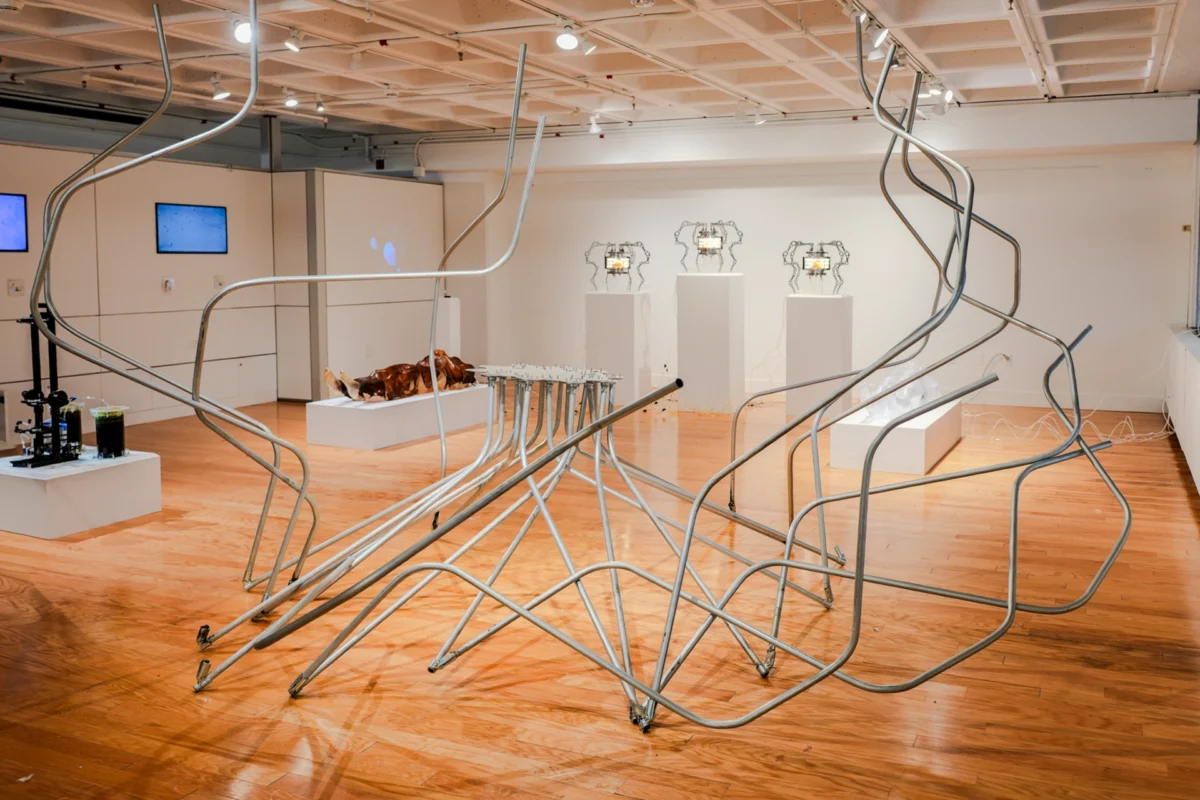
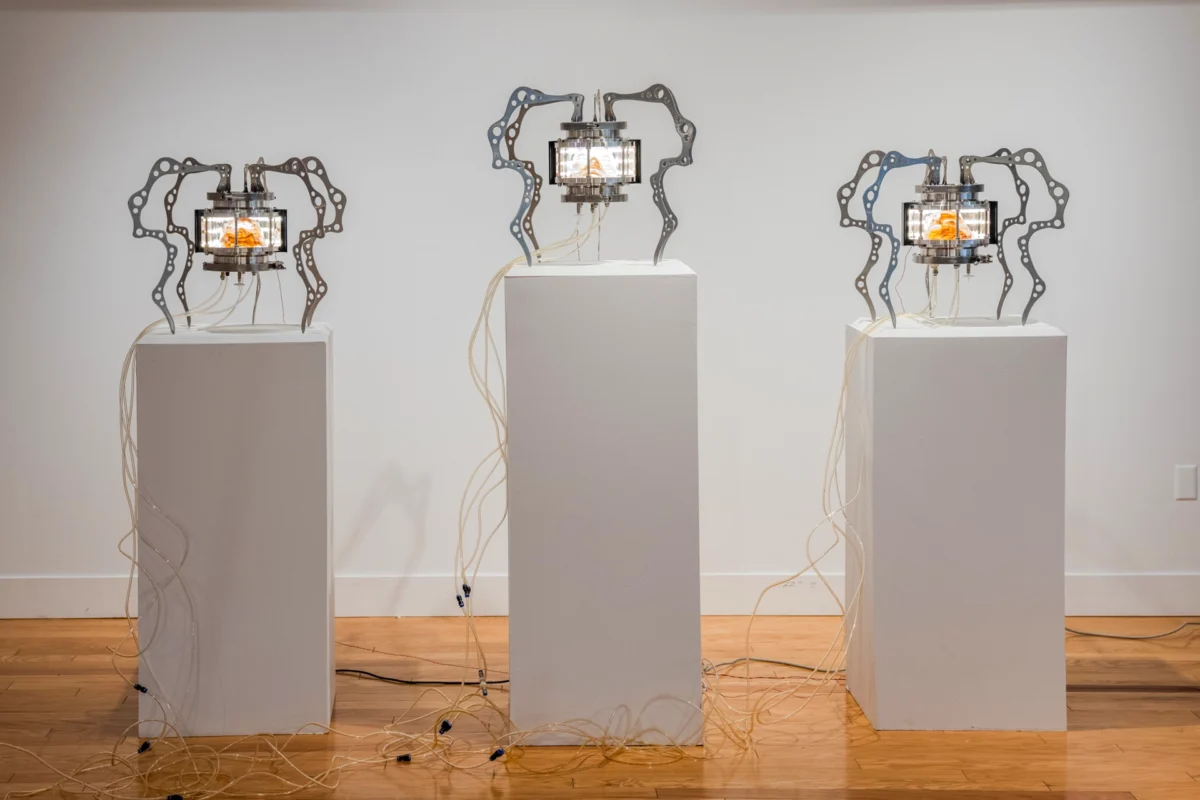
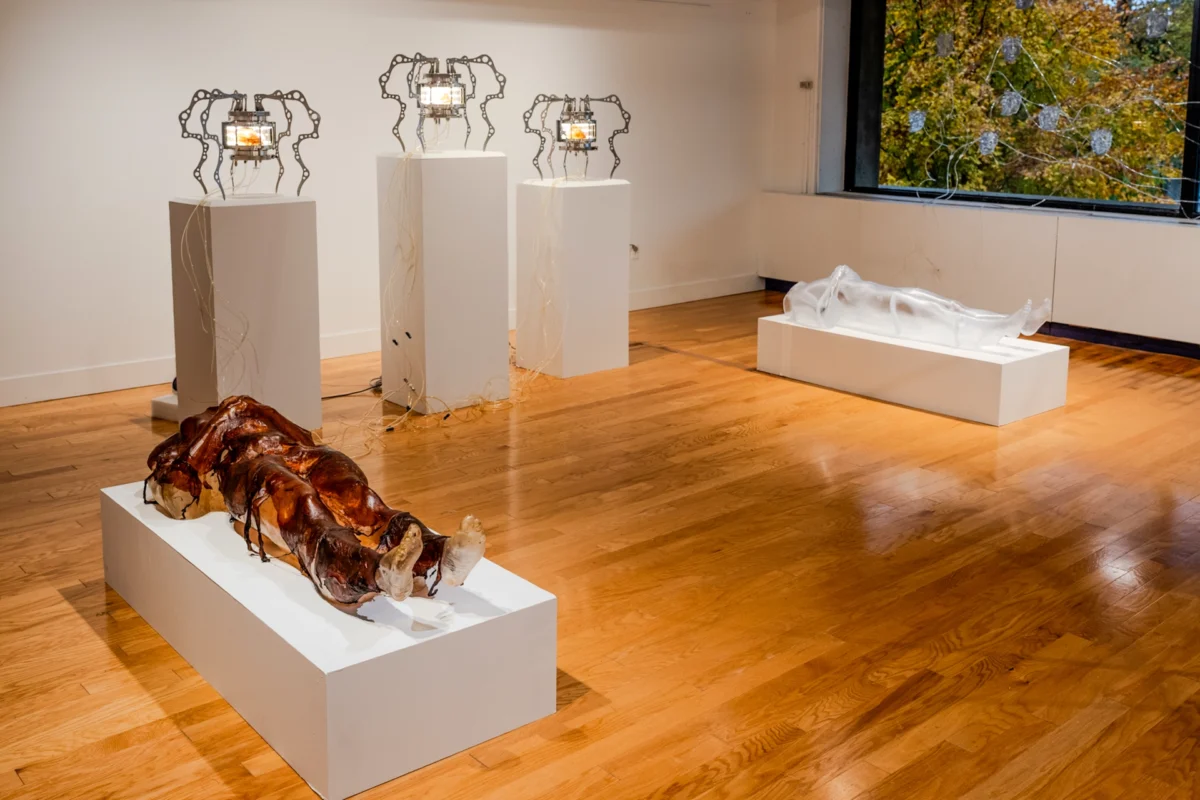
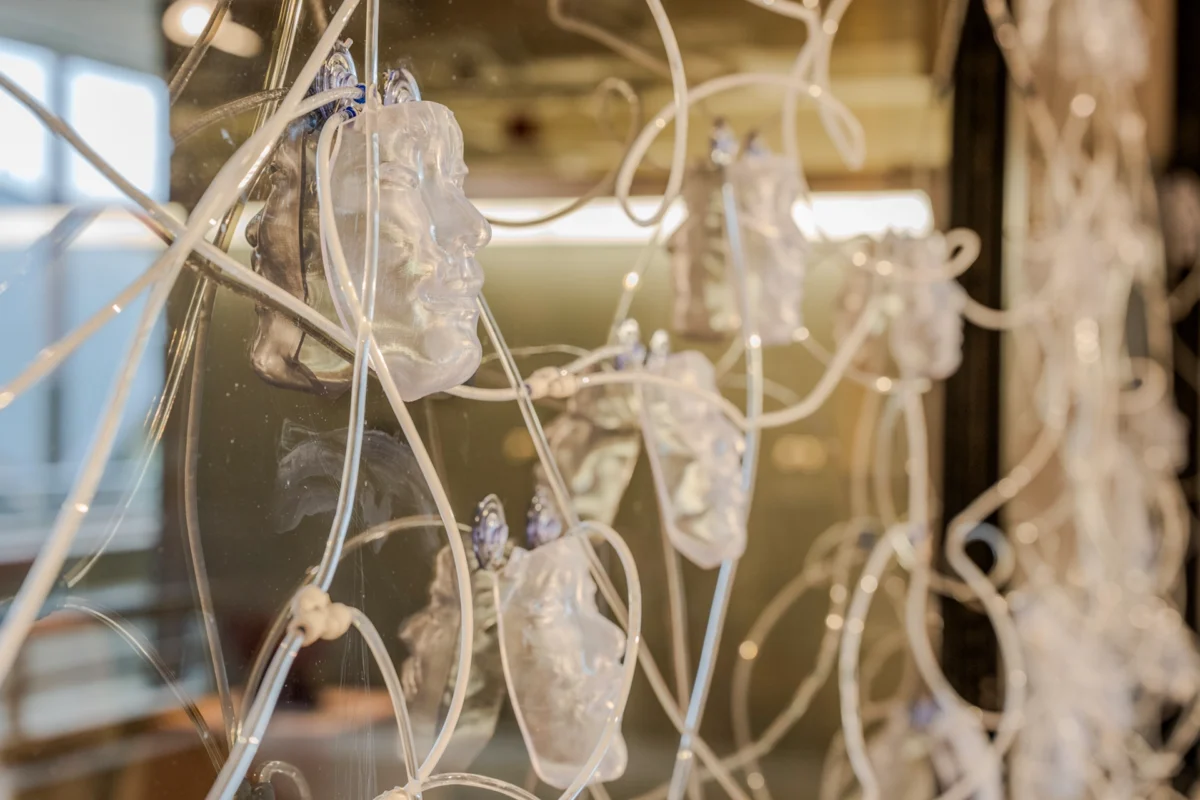
On entering the gallery, the visitor will encounter two mirrored and horizontal 3D-printed human bodies. One is a techno-futurist fountain—spawning fluid-filled tubes that connect to a family tree of mutating transparent masks, propagated by a genetic algorithm. The other has the eerie appearance of a mummified body, shrouded in a skin of kombucha leather.
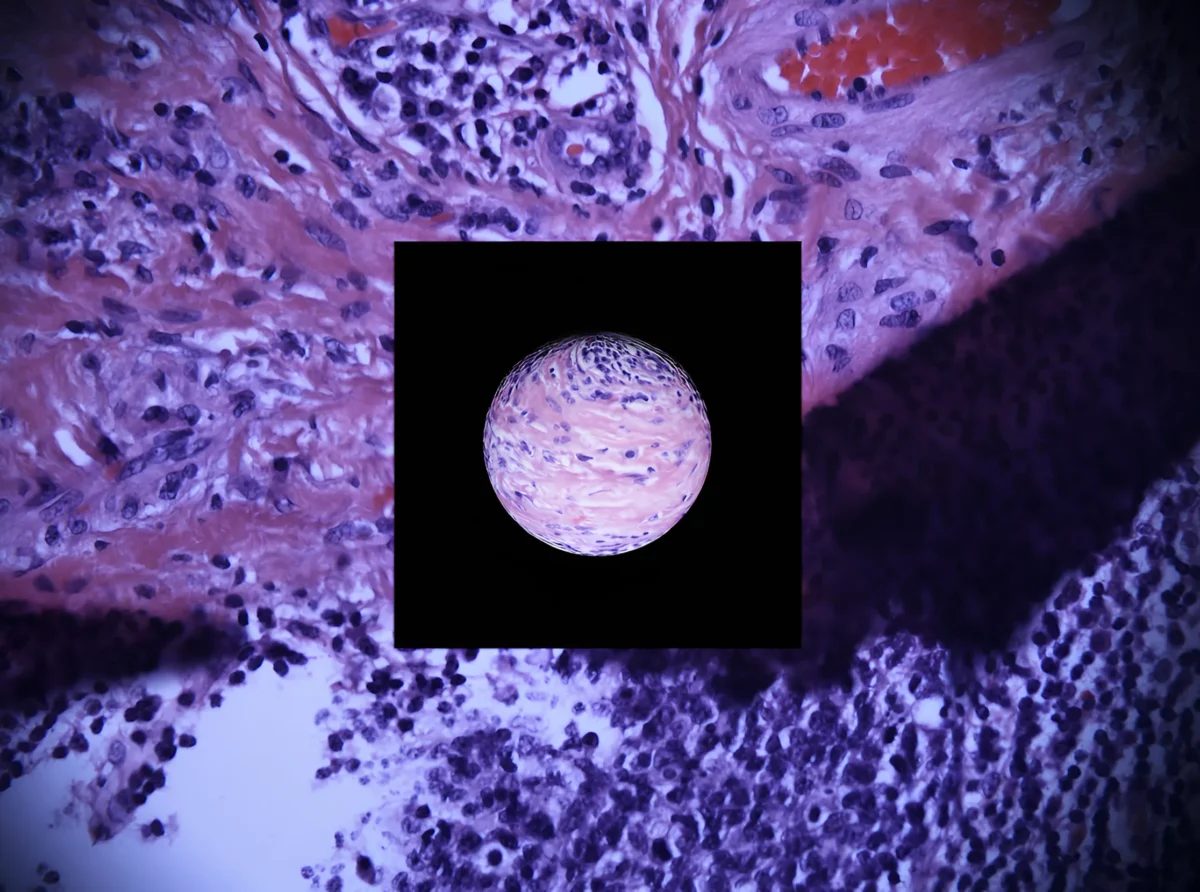
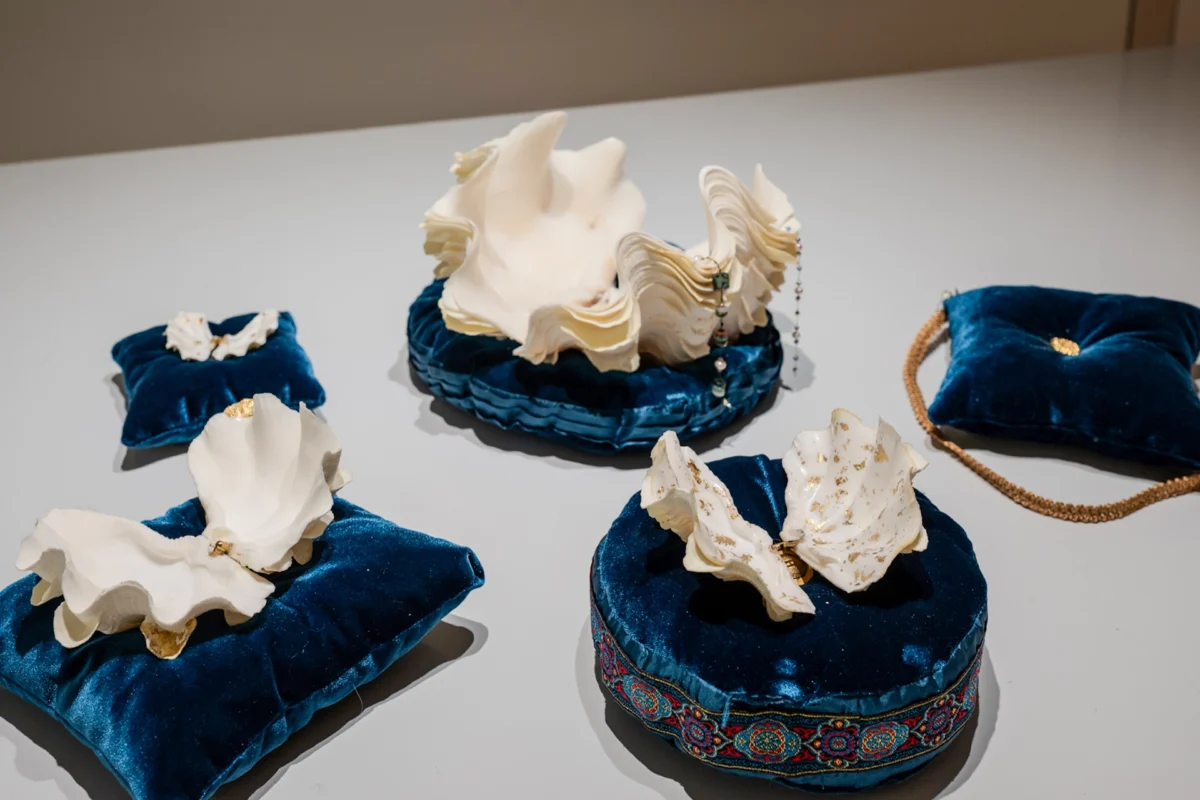
Elsewhere in the gallery, animate bioreactors have sprouted metal legs and cylindrical vats of pond scum are home to enclosed ecosystems. The chemical compositions of giant clam shells—read with a mass spectrometer—are interpreted as poetry, and a video of a solar system is projected through the legs of a 3-meter-tall metal spider. On closer inspection, the craters on the revolving planets turn out to be cells sliced from the artist’s tonsils.
Each artwork has its roots in a scientific premise. Art is reframed as process rather than product—a series of theoretical and aesthetic experiments, rich with what Tseo describes as “personhood.”
“How do we honor the individuality and nobility of cells?” Tseo wonders. “And not just cells—everything in the ‘stack,’ as it were. I think personhood can be extended throughout the biosphere. We look beyond the Earth to encounter alien life, but it’s enough to look down a microscope—to consider the parallels to our own societies, cultural life, and forms of self-expression.”
Giving Back to Gaia
Although presented as the work of an individual artist, Connecting Gaia can be considered as a collective exhibition—a teaming ecosystem of co-evolving life-forms.
“Each work—and the exhibition as a whole—is like taking a bite out of the crazy connected graph of Gaia,” Tseo reflects. “Because Gaia has so many nodes and edges, all you need to do is extract and contain a sample for it to become its own biosphere.”
As a result, questions of artistic originality, attribution, and ownership soon become murky. To rebalance the dynamics of give and take, Tseo has envisioned a way of “giving back to Gaia”—using AI to design unprecedented new proteins and introducing them to Gaia as a work of conceptual art.
“I’ve designed three plasmids (DNA constructs) to encode these new proteins—each optimized to be readily incorporated by a wide host of microbes. So, theoretically, I should be able to add a couple of drops of these plasmids into a puddle and—bam! They enter Gaia.”
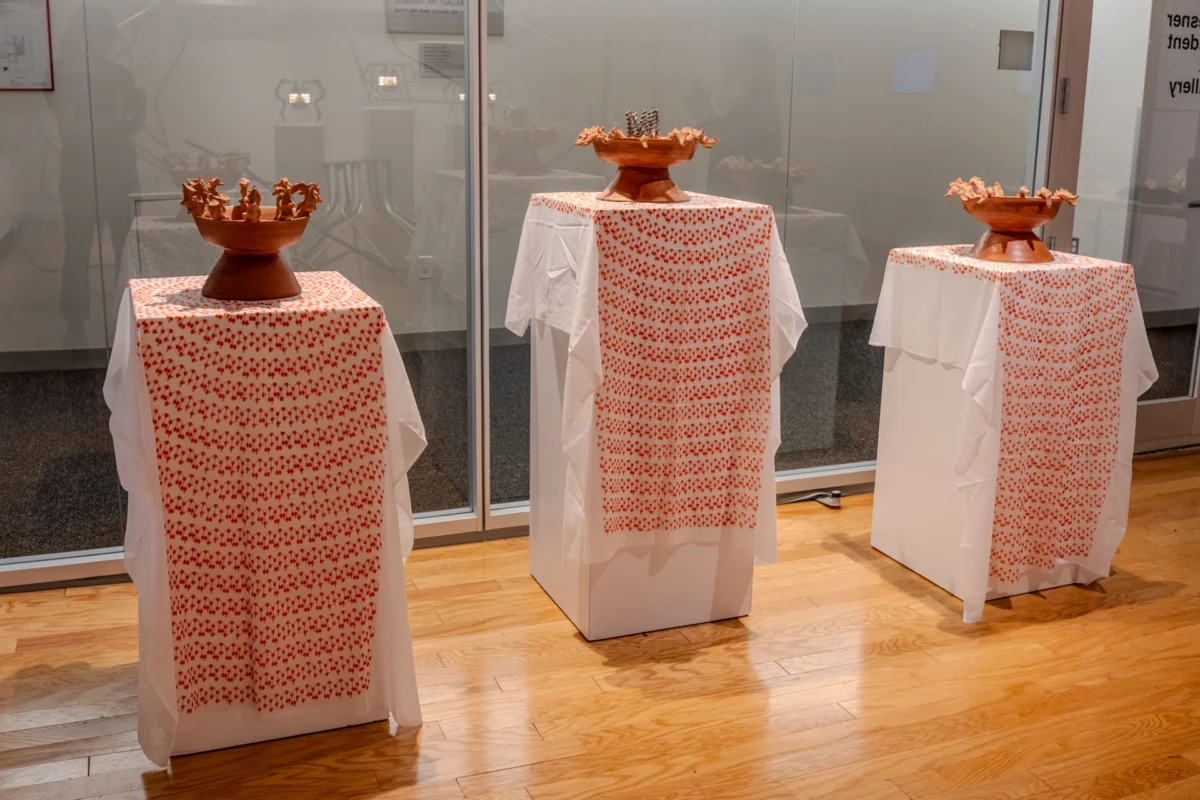
In the exhibition, DNA models are presented as libations at the center of Tseo’s handmade ceramic vessels. Inspired by the biomorphic ancient pedestal bowls of Mexico’s Puebla-Tlaxcala region, the ceramics could have been excavated from an ancient archeological site—or perhaps another planet. “We can’t hoard what we create,” said Tseo. “As part of Gaia, we are bound by a contract of reciprocity—as artists and scientists, we have the freedom to discover what that might look like.”
Participating in Beauty
The majority of works in the show were created specifically for the exhibition, but they can also be understood as iterations of earlier life-forms. Previous versions of the ceramics were presented at the Student Arts Showcase / MIT Gala at the MIT Media Lab in 2024, and a residency at Ars Electronica’s Futurelab in Austria was a chance for Tseo to test the technology he has developed for generating bacterial biofilm.
Next, Tseo will be advancing his ideas in collaboration with researchers at Auckland Bioengineering Institute (ABI) and the University of Auckland, traveling to New Zealand with the support of a Fulbright grant. His goal is to “grow” a new type of degradable robot composed entirely from sustainable biomaterials—specifically, the preserved muscle fibers of chickens. “Evolution has already created beautifully fine-tuned, complex, and delicate bodies,” Tseo reflects. “By re-using those materials to strengthen and advance our capacities in soft robotics, we add new connections to Gaia. I describe the project as ethical necromancy.”
Whether those robots should be classed as technological tools, artworks, or animate beings, is an open question. One thing is certain—they will be part of an ongoing experiment.
“I view all aspects of Gaia as experiments,” said Tseo. “It’s a matter of what connects or doesn’t connect—what new life evolves, what scientific theory persists, what art communicates and forms connections between us.” This approach to experimentation—both imaginative and empirical—is what makes the Wiesner Student Art Gallery different from other exhibition spaces. Artworks are ways of posing alternative questions; the gallery is a laboratory for material and conceptual experiments that build upon—and extend beyond – the scientific method.
In a society where creativity is valued in terms of human gain, Tseo finds freedom—and an alternative source of purpose—in Gaia’s decentering of our motives and aspirations. “As a participant in Gaia’s process of connection, I find myself part of something larger—a living system that has been around for 4 billion years and will continue to grow long after we’re gone,” he said.
“My purpose in Connecting Gaia is to introduce my perspective and actions to this collective emergent beauty. We all have a sense of what is good and what is beautiful. We all have our ways of sculpting Gaia towards or away from that vision—we are all artists of what comes next.”
This project was supported by a grant from the Council for the Arts at MIT and an MIT Design to Making Grant.
On Display: November 10–30, 2025 / Open 9:00am–6:00pm daily
Wiesner Student Art Gallery, Stratton Student Center, W20 Room 209, 84 Massachusetts Avenue, Cambridge, MA
Opening Reception: November 17, 2025 / 5:00–7:00pm
Free and open to the public; no reservations needed.
Written by Matilda Bathurst
Editorial direction by Leah Talatinian