
How MIT alumni created an experimental installation at the MIT Museum to turn our innermost worlds into collective experiences
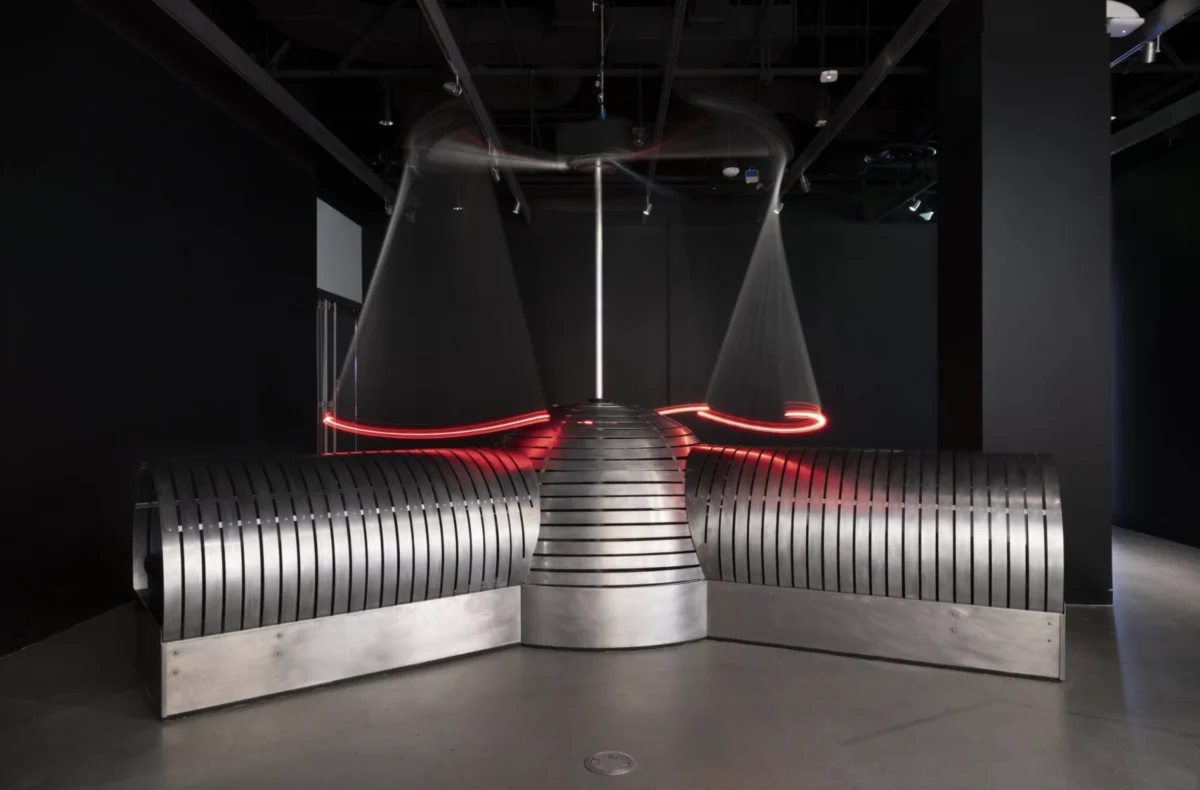
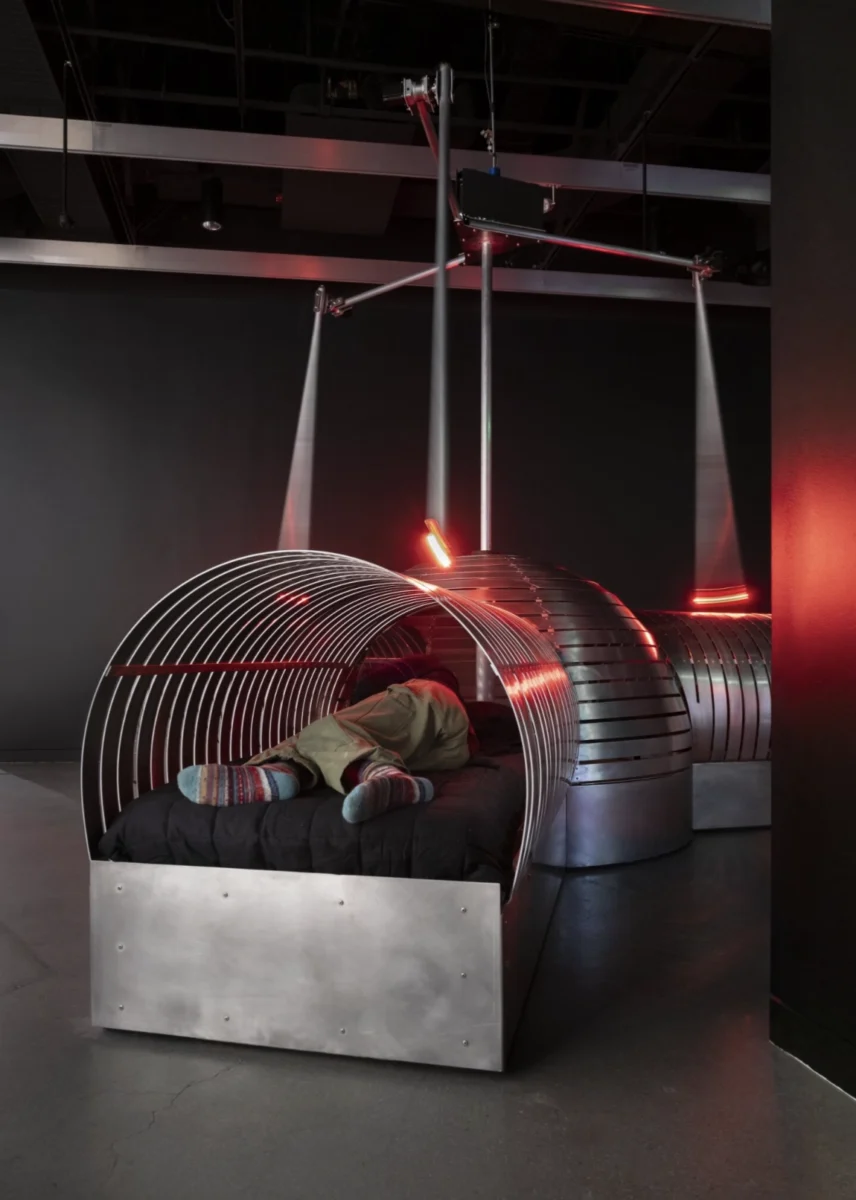
Hotel #2: Communal Dreams is composed of three handcrafted aluminum cylinders, each one equipped with a narrow black mattress, that converge at one bright central dome. “You slide into the tube, it feels like you’re a cosmonaut getting loaded into a rocket ship,” says dream scientist Adam Haar SM ‘19, PhD ‘22. Three mobile red lights, suspended on metal pendulums, swing above, trailing light and sound in calculated arcs. Each time the light swings overhead, the sleeper hears a noise emitting from inside the incandescent bulb, and feels its passing heat.
The installation is now on view as part of the MIT Museum’s exhibition Lighten Up! On Biology and Time, part of a year-long focus on the theme of time. It is designed to bring sleepers together, molding a common dream through the gentle interventions of sound, motion, and light. These sensory cues are designed to infiltrate the mind during the lightest stage of sleep—the brief porous phase between wakefulness and deeper sleep when dreaming begins.
The sculptural environment is the latest in a series of “dream hotels,” a collaboration between Media Lab alum Haar, MIT Museum Studio Director and CAVS alum Seth Riskin SM ’89, and former CAST Visiting Artist Carsten Höller. Drawing upon MIT’s groundbreaking research in dream engineering, the idea for these experimental prototypes is to create what Haar calls “an amusement park for the unconscious,” probing the permeable boundary between waking and dream, while extending the research lab into the public space of the museum.
Throughout history, different cultures around the world have turned to dreams as important carriers of meaning. Dreams, too, have long been the fascination of artists who found inspiration in their surreal departures from the constraints of rational society. But it is only until recently that scientists like Haar have begun to take dreams seriously as objects of scientific study.
“Dream engineering, which began at the MIT Media Lab’s Fluid Interfaces group, is a relatively new field. “There has barely been dream science in the last 100 years,” Haar says, “but now it’s a renaissance.” While much research has been done on sleep, dreams were once dismissed as unworthy of scientific attention, even as they constitute a major portion of the human experience. “We’re majority dreamers,” Haar says, noting how our minds are constantly wandering, dipping in and out of hypnagogic states. But dreams—“just the thoughts that you have at night”—turn out to be consequential. Frequent bad dreams, Haar notes, are as damaging as a poor diet or smoking in terms of early mortality. On January 10-11, 2026, 150 scientists, designers, engineers, and entrepreneurs will gather for the Dream Engineering Symposium at the Media Lab. These are the people pioneering this new field, and they are gathering to decide collectively on what direction it will take
The origin of the dream hotel is as winding as the unconscious itself. When Haar began collaborating with Höller during the artist’s residency at MIT, he looped in Riskin, whose class “Vision in Art and Neuroscience” had been influential. “We wondered if the public could experience all these experiments that we were doing for their exploratory, aesthetic value, and less for extractive data,” recalled Haar, noting how the idea fit well with Holler’s participatory installations that often challenge perception through play.
The resulting experimental prototypes, supported by the Center for Art, Science & Technology, first debuted at a “daydream night” at the MIT Museum Studio in 2022, where “there were dream-generating teas, a live sleeper, and inflatable pajamas that put pressure on your limbs to guide your dream content,” says Haar. An installation, which produced dreams of flying by gently rocking a round bed, then exhibited at the Fondation Beyeler and LUMA Arles, resulting in a scientific paper that appeared in Dreaming, a publication of the International Association for the Study of Dreams.
The integration of the aesthetic and scientific for Hotel #2: Communal Dreams happened in the Museum Studio, where students helped work on every phase of the project: prototyping, iterating, and working with fabricators to realize an ambitious installation. Together, faculty and students perfected the design. Hannah Zahr, a Technical Assistant for the MIT Museum Studio, was integral to the project. The structure’s apertures—along the bed tubes and dome—slice moving light into sweeping bands that pass over sleepers’ closed eyes. These bands create 4–8 Hz spatial and temporal rhythms meant to guide the brain into pre-sleep and influence dreams. Their direction and speed can be adjusted to shape the patterns carried into sleep.
Over the course of a summer, thirty MIT students took turns sleeping inside the structure. Each nap, lasting an hour and a half, was meticulously prepared. In the Studio, sleepers were led by Haar’s instructions: Light, sound, and motion will guide you gently, as if the room itself were dreaming with you. Afterwards, the Studio team interviewed the students about their experiences. “Reports from the students were critical to the concept of the artwork,” says Riskin. How should the light move, at what speed and in what direction? How could it work with the sound? What would be most effective? “It was all useful information that helped shape the piece.”
The resulting installation blurs the line between art and participant. To enter is not just to observe, but to become part of an ongoing experiment—with the final artwork being the dream itself. The sensory stimuli, as previous studies had shown, had shaped a common dream of movement. Participants described visions of traveling through tunnels, swaying overnight on a boat, or even patterns like “little footsteps on the eyelids.” This shared theme united the dreamers in a collective experience. “The first thing that happens when you sleep with two strangers in a strange space is that you turn your heads inwards to this shared dome,” says Haar, “and start having an intimate, vulnerable conversation about these emergent threads of sameness across this otherwise invisible part of yourself.”
If there is a sense of nakedness to sleeping in such close proximity, the novelty of the scenario is a relatively new phenomenon, Haar argues. For much of human history, extended families shared bedrooms, and dream sharing traditions were more common. Nocturnal visions formed a shared cultural vocabulary with which to make sense of the world. Sleeping alone, Haar says, is a product of industrialization, and reflects a larger social trend towards increasing isolation and individualism. “This is just one of the ways in which we’ve constructed the built world to isolate ourselves psychologically,” he says, “and what are the consequences in terms of empathy?”
“Art is a material dream,” says Riskin, who studied under artist Otto Piene at MIT’s Center for Advanced Visual Studies (CAVS), and whose work has long explored light as a creative medium. “What art does is to explore the human inner world by outer means. That’s the territory of MIT, mind and hand.” Many students today, Riskin says, are disconnected from deep exploration of their inner lives, and that visual art—especially in the MIT tradition—provides a subjective mode of research and production that is complementary to the objective methods of science and engineering. “Being involved in a project like this lets students learn about art as a vehicle for probing, shaping, sharing the internal dimensions of human experience, their own and their communities,” says Riskin, “I think at this time humans are looking for humanness.”
In the end, the work asks, in both the physical and cultural sense: how do we dream new worlds into being? How might dreams function as a form of communal imagination, creating possibilities for new realities? “Whose shared dream are we living in right now, and what would we have to do to share a different dream?” Haar says, “It starts with the really simple practice of sharing dreams. It starts with the simple practice of making your interior less invisible to others.”
Lighten Up! On Biology and Time is on view at the MIT Museum until August 2026.
Written by Anya Ventura
Editorial direction by Leah Talatinian