
A collaboration between two visiting artists, MIT faculty, and students breathes new life into a revered and endangered textile tradition
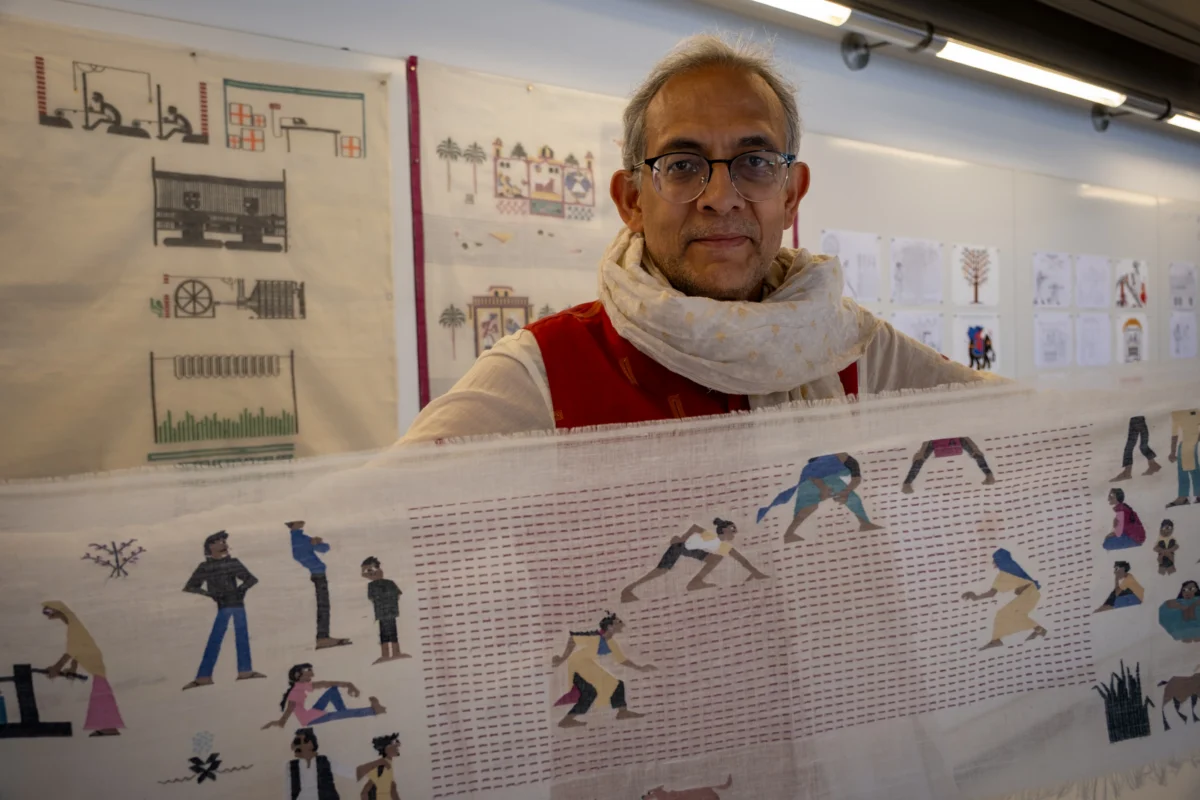
The fabric is so fine that you can read through it. Muslin, a hand-woven cotton textile originating in Bengal more than 2,000 years ago, and jamdani, its globally famous decorative form, earn the name “woven air” for their translucency and delicacy—qualities that emerge from a process unlike any other form of weaving. The patterns are not printed, dyed, or embroidered onto the finished cloth. Instead, weavers introduce a separate, supplementary weft thread directly into the loom, building each motif row by row as the fabric itself takes shape.
It is also a craft in crisis. British colonial policies dismantled the Bengali weaving economy in the 19th century. The Bangladesh government has worked to revive it as part of the national patrimony, and UNESCO added jamdani to its Representative List of the Intangible Cultural Heritage of Humanity in 2013, but mechanized textiles and fast fashion continue to erode the market for handwoven cloth. Younger generations in weaving communities are increasingly reluctant to take up a trade that demands extraordinary skill for modest pay. Even with growing interest from contemporary designers and artists in Bangladesh and India, the question of how to keep jamdani alive—and on whose terms—became the animating problem of a yearlong collaboration at MIT that culminated this spring in the pop-up exhibition Flying Fingers.
The project brought together Nobel laureate Abhijit Banerjee, the Ford Foundation International Professor of Economics and a native of India; Azra Akšamija, the Aga Khan Professor and director of the Art, Culture, and Technology program (ACT); CAST Visiting Artist and Woolmark Prize–winning fashion designer Suket Dhir; CAST Visiting Artist and illustrator Cheyenne Olivier; and MIT students. Supported by a 2025–26 Visiting Artist Grant from the MIT Center for Art, Science & Technology (CAST) and the MIT Human Insight Collaborative (MITHIC), the residency grew out of a collaboration that began in 2021 through sustained exchanges with Raghunath Sinha, who runs VillageWear, a textile company based in Beninagar, West Bengal. It was rooted in Banerjee’s long-standing research on craft sustainability and his conviction that economics alone cannot account for the value of what a weaver’s hands produce.
The residency unfolded along two tracks. Dhir and Olivier each developed new bodies of work—wearables and standalone art pieces—in dialogue with the master weavers, while cinematographer Ranu Ghosh, a longtime collaborator of Banerjee, documented the weaving process on film. Akšamija’s fall 2025 course brought students into the collaboration, tasking them with designing original jamdani patterns of their own. The two efforts were distinct but deeply related, connected by the same group of weavers, the same craft, and the same set of questions about how to engage with a living tradition responsibly.
“As an economist, we are not really trained to think about beauty,” Banerjee said. “It’s functional—people buy it, that’s the value. Part of what we want to bring into economics is the idea that there is some other dimension called ‘beauty,’ called ‘good design,’ which has a complex relationship with economic success.”
Designing with care
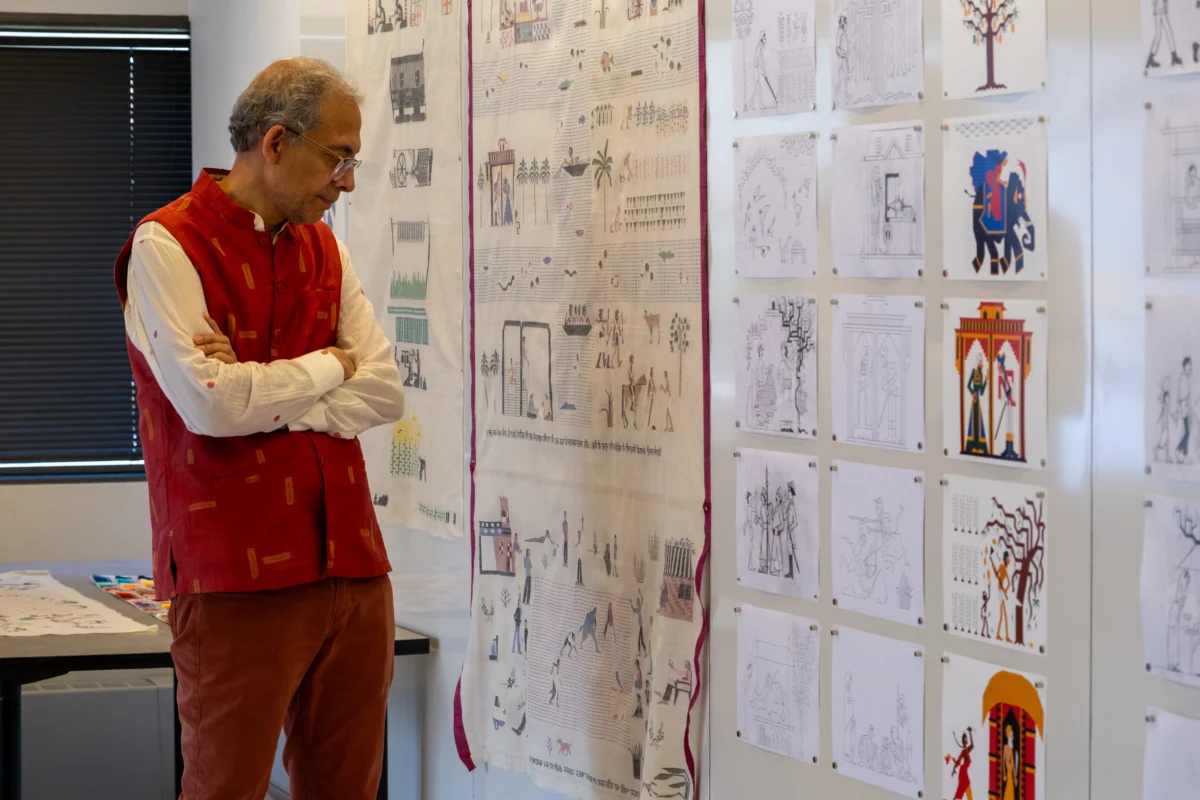
Akšamija’s course, 4.378U/4.379G (Future Heritage Workshop: Experiments in Textile Crafts), spent several weeks centered on jamdani, and the assignment was deceptively simple: each student would design a roughly twelve-inch square pattern, which would then be woven by hand by master weavers Kashem Ali, Hasan Shiekh, and Abdul Jabbar in West Bengal, India. But knowing their designs would actually be produced—that real artisans would invest weeks of labor in the results—changed what it meant to draw a line on paper.
Jamdani carries its own visual language drawn from the local Bengali environment: plentiful flowers, vines, and creepers. Rather than ask students to replicate that vocabulary, Akšamija and her collaborators posed a different challenge. Each student would design a motif rooted in their own sense of place, requiring them to learn the craft from the inside. They studied what a supplementary thread can and cannot do, how line weight reads at the scale of a loom, and what dialogue with a weaver looks like across continents. Olivier and Dhir offered guidance and feedback on the students’ designs, drawing on their close familiarity with the craft and the weavers’ technical knowledge to bridge the gap between concept and execution.
“The knowledge of the hand, the kind of agency of the human body and the traditional knowledge that accumulated over generations—how do we preserve that value for the future?” Akšamija said. “How can designers work ethically and meaningfully with craftspeople around the world?” Cultural appropriation, she noted, is not an abstract concern. “At what point is something being appreciated, or is something being appropriated, and someone is just making money out of a marginalized community?”
Place as pattern
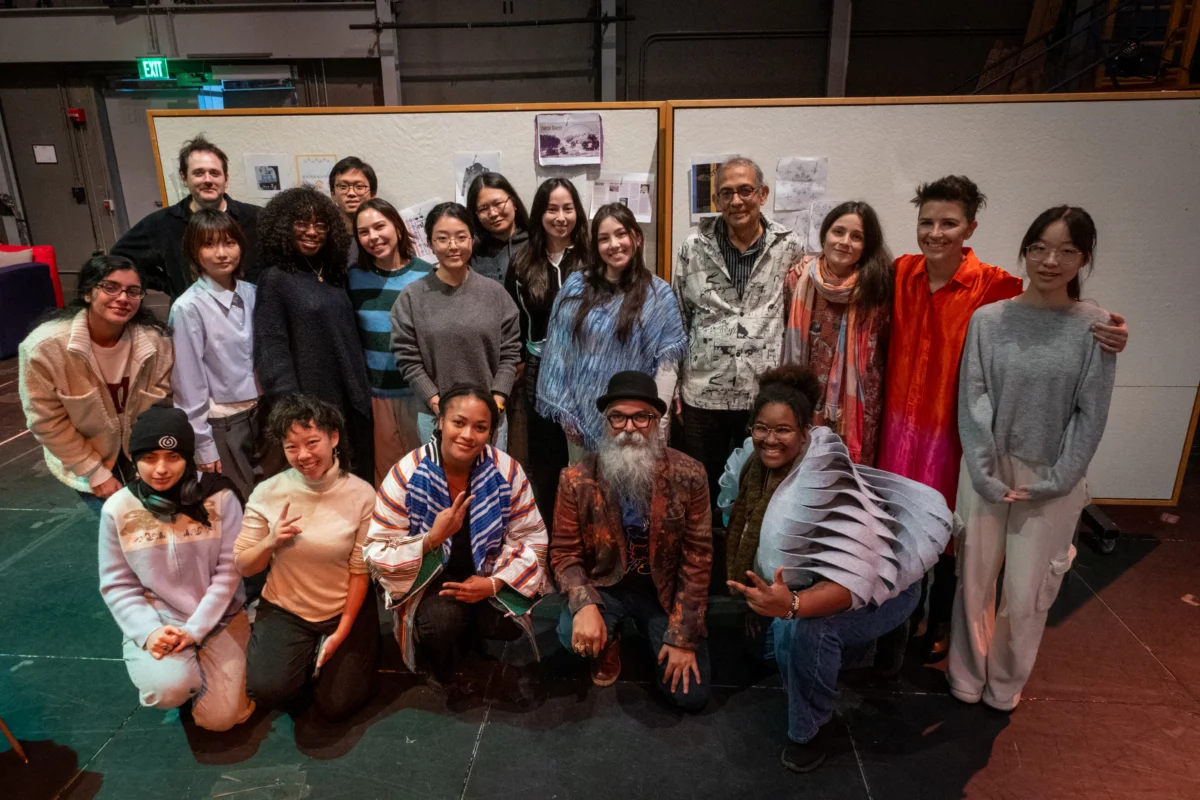
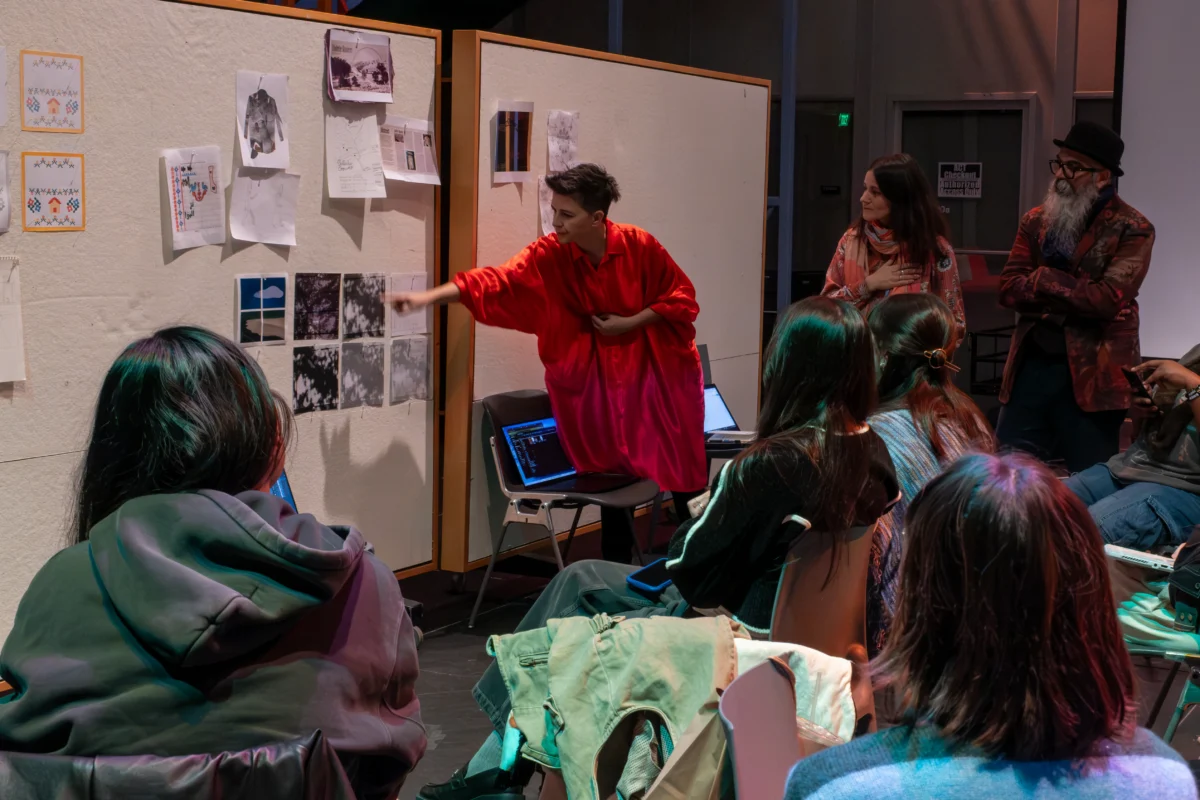
Most students responded to the challenge with designs inspired by the MIT campus. Ya (Zoe) Gao MArch ’28 created an infographic-style map of the green spaces around the Institute. Mica Caine MCP ’26 took a more personal route, designing a map tracing her family’s path to the United States. “We’re having really cool conversations,” Caine said. “What does it mean to produce this craft and create this craft and drive engagement with the craft? What are ethical forms of fashion, and how do we bring back that sacredness into what we wear?”
Among the many thoughtful responses, Valeria Dueñas MArch ’28 photographed the shadows cast on the wall of Building E15 and translated them into line drawings to be woven. The finished textile, with its slightly heavier supplementary thread against translucent cotton, casts shadows of its own. Shadow became drawing became fabric became shadow again.
A craft’s history, woven into cloth
Flying Fingers opened on April 24, 2026 in Building E15, presenting student textiles alongside contributions from the visiting artists. Olivier is creating a set of five narrative scrolls depicting the history of jamdani from the 18th century through the colonial decimation of the Bengali weaving industry to the present day, developing an illustrative language through close work with the weavers that could be translated into the fabric itself. Master weavers Selina Bibi Mallick and Habibul Mallick are weaving the illustrated narratives into ultrafine cotton scrolls; three are now complete.
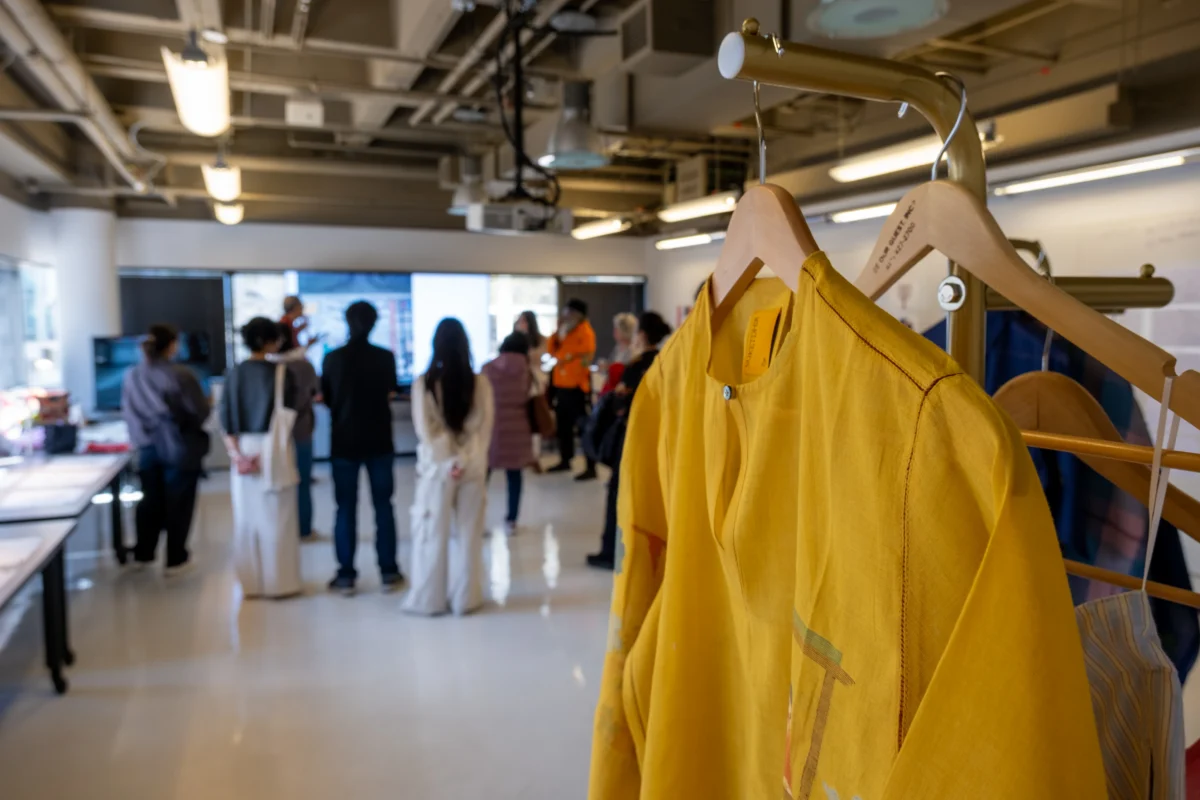
Dhir premiered a new line of clothing developed through the residency, each piece a conversation between traditional jamdani motifs and his own sensibility for concealed detail and visual surprise. His patterns nodded to the traditional vocabulary—parrots, mango trees—but embedded cartoon-like characters and playful flourishes that reward close looking, consistent with the designer’s longstanding approach of hiding delights in a garment’s lining or weave.
“The larger idea is to bring people’s attention to jamdani, but also to the economic challenges that jamdani weavers are facing,” Olivier said. “How can we, as designers, make patterns that are both true to the traditional aesthetic, but also renew this aesthetic?”
A circuit, not a line
When the weavers first received Olivier’s intricate illustrations, there was pushback: too difficult and too time-consuming. The final products, however, exceeded what anyone on the MIT side had imagined. “Every time we underestimated this weaver,” Dhir recalled, “he’s come back like, ‘Do you have something more difficult? Bring it on.’”
What returned from West Bengal bore the weavers’ fingerprints as much as the designers’. Student designs, Olivier’s historical scroll, and Dhir’s new clothing line all traveled to India and returned transformed—not as outputs of a production line, but as work that reflected the weavers’ own judgment and skill.
“Cross-disciplinary collaboration is at the heart of a project like this,” Banerjee said, “because our goal is to understand how to give a traditional craft a life in the modern world.”
That goal requires the kind of exchange this residency modeled: one in which the knowledge accumulated in a weaver’s hands is met with attention, care, and designs worthy of the craft that will carry them.
Written by Tim Lemp
Editorial direction by Leah Talatinian
The residency was supported by a 2025–26 Visiting Artist Grant from the MIT Center for Art, Science & Technology (CAST) and the MIT Human Insight Collaborative (MITHIC). CAST residencies allow artists to focus on the research and development phase of their work and to engage with ongoing teaching, artistic creation, and scientific exploration across campus.