Jordan Rudess
2023-24 CAST Visiting Artist
2025-26 CAST Distinguished Visiting Artist


Jam_Bot: Exploring the Potential of AI in Live Collaborative Musical Performance
About the Residency
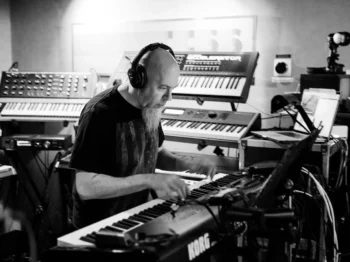
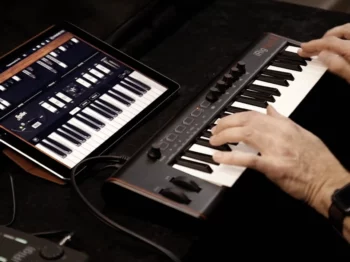
Renowned musician Jordan Rudess collaborates with Professor Joe Paradiso and the Media Lab Responsive Environments Group to create new technology that probes the boundaries of where AI meets musical control and expression. A machine learning model trained on Rudess’s playing style and technique improvises and performs live in a duet with its human counterpart. Sometimes leading, sometimes following, the model and human together create new and unique music that interacts in real time with a physical installation that responds to and influences the behavior of the model.
Over a series of visits to campus, Rudess shares his perspectives on music technology, performance, and technique through workshops, guest lectures, and a collaborative concert.
Originally welcomed as a Visiting Artist in 2023, Rudess received an appointment as a Distinguished Visiting Artist in 2025 in order to expand the research to enable more collaborative uses, incorporate expressive playing into the AI models, explore different modes of visually depicting AI intent for both performers and audience, broaden the span in musical style of our models (or better integrate them), and expand the creative reach of the system.
Schedule
Past Events
Rocking with the Machine: Jordan Rudess and the Future of Live AI Music Talk
Featuring Lancelot Blanchard and Perry Naseck
Tuesday, March 17, 2026 / 5:00pm
MIT Room 4-237
2025–26 CAST Distinguished Visiting Artist Jordan Rudess traces his path from classical training to pioneering musical innovation—including the development of Jam_Bot, a tool for real-time collaboration between human performer and AI—and offers an honest look at where the technology stands today and where it might take us next. Rudess is joined by MIT Media Lab PhD candidates and collaborators Lancelot Blanchard and Perry Naseck.
Jordan and the jam_bot: A Work-in-Progress Performance
September 21, 2024 / 8:00pm
MIT Media Lab 6th Floor Multipurpose Room, Building E14
A work-in-progress performance of new technology that probes the boundaries of where machine learning meets musical control and expression, created by Jordan Rudess and the MIT Media Lab Responsive Environments Group.
Emerson/Harris Masterclass with Jordan Rudess
September 23, 2024 / 5:00–7:00pm
Killian Hall, MIT Building 14
A masterclass with Jordan Rudess exploring composition, improvisation, and student performances of Jordan’s work.
Learn more
Open class with guest speaker Jordan Rudess: MAS.837 Principles of Electronic Music Interfaces
Tuesday, April 9, 2024 / 12:30-2:00pm
MIT Wiesner Building, E15-341
Open to MIT ID holders
Residency visits:
April 2024
May 2024
September 2024
Fall 2025
Collaborators at MIT
Lancelot Blanchard is a musician, engineer, and AI researcher pursuing a PhD at the MIT Media Lab’s Responsive Environments group. His research explores the development of Generative AI systems that facilitate human-AI co-created live musical performances, to improve the creative processes of musicians on stage. Lancelot is currently a LEGO Papert Fellow and an Emerson/Harris Fellow, and was an MIT Presidential Fellow. He holds a Master’s of Research in Artificial Intelligence and Machine Learning and a Master’s of Engineering in Computing from Imperial College London, as well as a degree in classical piano from the Conservatory of Rennes, France.
Website: lancelotblanchard.com
Perry Naseck is an artist and engineer working with interactive, kinetic, light- and time-based media. He specializes in interaction, orchestration, and animation of systems of sensors and actuators for live performance and permanent installation. Perry completed a Bachelor’s of Engineering Studies and Arts at Carnegie Mellon in 2022 where he studied both Art and Electrical & Computer Engineering. He worked at the Hypersonic studio in Brooklyn, NY where he created large interactive, kinetic, and light public art installations found all over the U.S. and abroad. Perry is Research Assistant in the Responsive Environments group at the MIT Media Lab where he focuses on creating new experiences that bridge the gaps between musicians, improvisation, and audiences.
Website: perrynaseck.com
Joseph Paradiso (Alexander W Dreyfoos 1954 Professor; Academic Head, Program in Media Arts and Sciences) directs the Responsive Environments group, which explores how sensor networks augment and mediate human experience, interaction, and perception.
Full bio: MIT Media Lab
With thanks to Irmandy Wicaksono, whose Knitted Keyboard inspired the initial collaboration.
Biography
Jordan Rudess is best known as the keyboardist/multi-instrumentalist extraordinaire for platinum-selling Grammy Award–winning rock band, Dream Theater. A classical prodigy who began his studies at the Juilliard School at the age of 9, his music is a unique blend of classical and rock influences. In addition to playing in Dream Theater and his solo career, Rudess has worked with a wide range of artists, including Deep Purple, David Bowie, Steven Wilson, Jan Hammer, Enrique Iglesias, the Paul Winter Consort, Annie Haslam, Liquid Tension Experiment (with John Petrucci, Mike Portnoy, and Tony Levin), LMR (with Tony Levin and Marco Minneman), Blackfield, Aviv Geffen, the Dixie Dregs, Rod Morgenstein, and Tony Williams among others.
His interest in state-of-the-art keyboard controllers and music apps is another area of his career in which he has achieved success. Rudess owns the successful app development company Wizdom Music, creators of award-winning apps such as MorphWiz, SampleWiz, and Geo Synthesizer. Wizdom Music’s latest app, GeoShred, was created in collaboration with moForte, founding members of Stanford University’s Sondius team. In addition, Rudess is the author of two keyboard technique books including his latest, Total Keyboard Wizardry: A Technique and Improvisation Workbook. Recently, he was an artist-in-residence at Stanford University’s Center for Computer Research in Music and Acoustics (CCRMA).
Website: jordanrudess.com
Social: X | Facebook | Twitter | Youtube