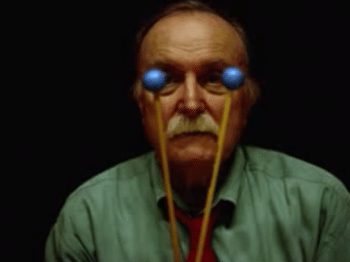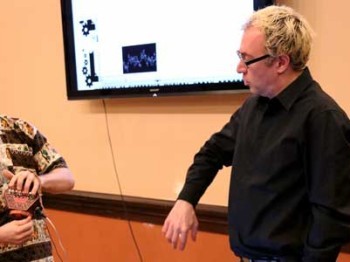
A man holds percussion mallets in front of his face.

MIT Sounding: New Annual Music Series

MIT Presents New Music Series: MIT Sounding Featuring World Premieres, Reconstructed Classics, and Grammy Award winning musicians in new concert series For the 2014-15 season, Massachusetts Institute of Technology (MIT) inaugurates the innovative annual performance series MIT Sounding, curated by … Continued

Hand-written text and a diagram of a human head from a historic document.

Seeing/ Sounding/ Sensing: CAST Symposium in Context

On September 26-27, CAST is convening artists, neuroscientists and scholars in the visual arts, music, physics, mathematics, history, anthropology and philosophy to participate in the symposium “Seeing / Sounding / Sensing.” Organized by MIT Professors Caroline A. Jones (Chair) and … Continued
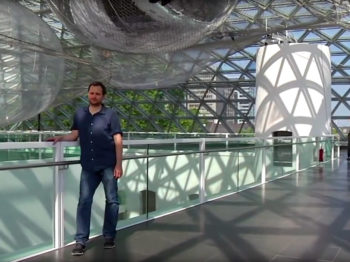
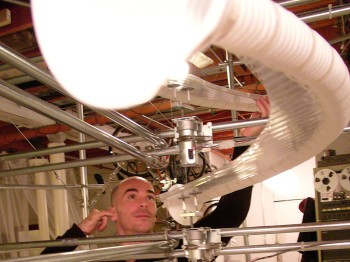
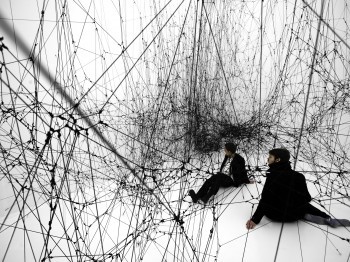
Tomás Saraceno’s "In Orbit" installation, a netted web that extends 65 feet into the air, in Germany’s K21 Staendehaus Museum.

Video: Visiting Artist Tomás Saraceno’s In Orbit

Check out our Inaugural Visiting Artist Tomás Saraceno’s newest installation, a netted web that extends 65 feet into the air, in Germany’s K21 Staendehaus Museum. For more information on the ideas that drive Saraceno’s work, read about his far-ranging conversations with MIT scientists and engineers on biomimicry, atmosphere, and cosmology.

Close-up of white bacterial growths of varying sizes on an agar plate.
Bacteria on an agar plate. Credit: Creative Commons

Painting with Bacteria

Spliced with the same protein molecule that causes jellyfish to light up so brilliantly, Tal Danino’s e. coli bacteria pulse and flash like blinking neon signs. Danino, an MIT postdoc in Dr. Sangeeta Bhatia’s lab at the Koch Institute for Integrated Cancer Research, programmed the bacteria to release the protein through a phenomenon called quorum sensing, a way in which bacteria communicate with one another in order to function as a group.

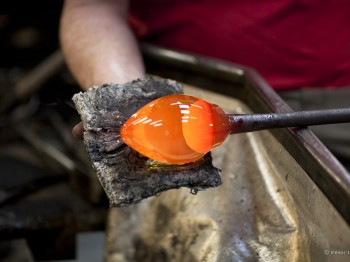
Close up of a hand working with molten glass at the end of a metal rod.
Credit: Trevor-Smeaton

MIT Glass Lab: Where Art Meets Science

“I was observing their observations,” said Peter McMurray, a doctoral student in Harvard’s Ethnomusicology program, who recently completed a short documentary on MIT’s new Glass Band, screening it on Wednesday as part of the program “The Lab as Observational Art.”

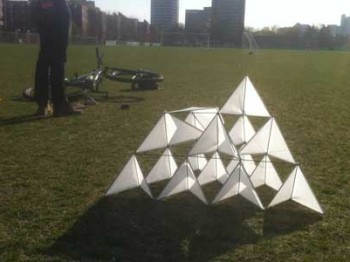
A kite made of many small white triangles on a green field.
A collapsible tetrahedral kite inspired by one designed by Alexander Graham Bell. Photo: Nadya Peek, Matthew Arbesfeld and James Coleman.

Reinventing Invention

An expandable table. A collapsible CNC router. Motorized wheels whose diameter can enlarge and contract depending on the terrain. These are a few of the examples of “transformable design” now on display from the course, “Mechanical Invention Through Computation” led by visiting designer, engineer and inventor Chuck Hoberman. The seminar, co-taught with MIT professors Erik Demaine and Daniela Rus from the Computer Science and Artificial Intelligence Laboratory (CSAIL), was driven by a simple question: How can you create new transformable objects?

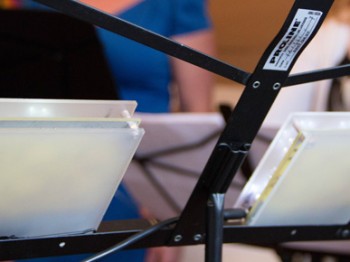
A music stand with two small white electronic devices.

Tristan Perich’s 1-Bit Symphony

Tristan Perich writes music in 1s and 0s. His is an art determined by the binary on/off logic of the computer, an art in search of foundational laws. He is interested in processes, scripts, and scores: cyclical and infinite sets of rules that illuminate the possibilities and limitations of the knowable world.

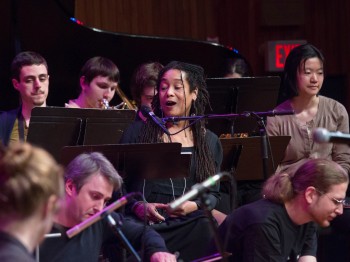
A woman sings into a microphone amid a group of musicians.
Pamela Z performs at the CAST Marathon Concert, MIT, 2013. Credit: L. Barry Hetherington.

CAST Marathon Concert


It was likely the first time Senegalese sabar drums, a cello, a didgeridoo, an accordion, a piano and panpipes made from test tubes all occupied one stage together. A follow-up to 2011’s FAST Forward Marathon concert, the concert celebrated the convergence of art and technology — from simple percussive acts to the most sophisticated gestural controls — and showcased the many creative tools and techniques used by artists from MIT and beyond.

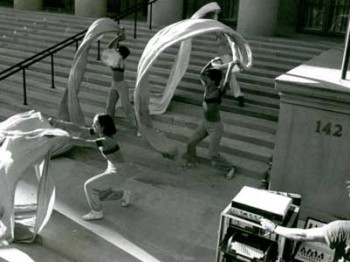
Dancers wave long pieces of fabric in the air on a stone staircase.
Christopher Janney, "Soundstair On Tour, Rehearsal." 1979. Photograph: Anne Bray.

Music/Tech: Christopher Janney

In 1976, Christopher Janney was one of only four graduate students to enroll in MIT’s new masters program in Environmental Art, where he first began his formal experiments combining architecture and jazz under Otto Piene, Director of MIT’s Center for Advanced Visual Studies, founded in 1967. His thesis, “SOUNDSTAIR: The Nature of Environmental/Participatory Art,” was performed on many iconic stairways — from the Spanish Steps in Rome to MIT’s own Building 7 — in which the dancer’s footsteps would trigger sounds, altered in real-time by Janney. In essence, the entire building became a musical instrument.

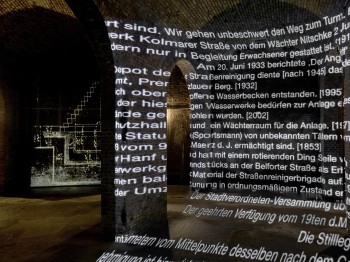
German words projected on brick arches.
Turntable History by Arnold Dreyblatt

Visiting Artist Arnold Dreyblatt’s Magnetic Resonances

I first heard Arnold Dreyblatt’s music while couch surfing in the early 1980s, in a loft in what we still were getting used to calling Tribeca. The picture on the album cover was enough to do it for me, but the music was something else entirely. Metallic shards of overtones, emanating from what I eventually learned to be Arnold’s bass, in simple but mesmerizing rhythms, shooting off in all directions, latched onto by other instruments with similarly resonant qualities – his Orchestra of Excited Strings.

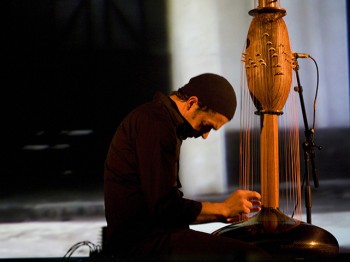
A man plucks strings on a large instrument made of wood and strings.
Victor Gama plays the TOHA, 2012. Credit: Niklas Zimmer.

Visiting Artist Victor Gama Creates Futuristic New Instruments

Victor Gama is a composer whose process begins with the creation of an entirely new instrument, one whose design is steeped in symbolic meaning. Concept design, the selection of materials, fabrication, and scoring is all part of the rigorous way Gama creates new music for the 21st century, blending current fabrication technologies with ideas, materials, and traditions inspired by the natural world.

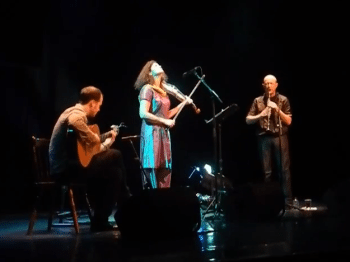
A guitarist, bass clarinetist, and singer rehearse.

EVIYAN Premieres as part of CAST Spring Sound Series

The musical trio EVIYAN was born in vocalist-violinist Iva Bittová’s house in the woods of the Hudson Valley after a few bowls of mushroom soup. In that rustic setting, performer-composers Bittová, Gyan Riley and Evan Ziporyn came together for the first time to create the kind of loose musical tapestries — weaving elements of the classical, folk, jazz, minimalist and global traditions — that debuted to high acclaim on Saturday, March 2 at MIT’s Kresge Auditorium. “It felt like a family reunion,” says Ziporyn, Kenan Sahin Distinguished Professor of Music and Faculty Director of the Center for Art, Science & Technology.

A student and a visiting artist talk in a music class.
Eric Singer and student Otto Briner in the "Music and Technology" class, Spring 2013.

Music/Tech: Eric Singer

The Sonic Banana, both playful and ingenious, is emblematic of Singer’s work. Singer is the founder of LEMUR, the “League of League of Electronic Musical Urban Robots,” a collective of artists and technologists who create robotic musical instruments. A self-described “engineer of very strange things,” Singers works as a musician, artist, and computer scientist to create interactive installations from unusual materials. Created with a DIY ethos, his instruments are playful, interactive, and intuitive. His philosophy: “How do I take things that aren’t musical instruments and turn them into musical instruments?”

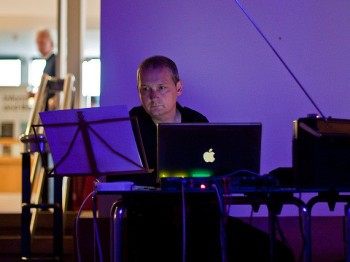
A man sits behind a laptop and a music stand.
David Sheppard

Music/Tech: David Sheppard

“The room is the most important instrument I play,” Sheppard said. In 2011, he transformed the entire concrete hulk of a former Nazi submarine station into a musical piece, drawing attention to the acoustic properties of the airport-sized docking point while at the same time creating an environment for other musicians to inhabit. Alone and with others, he calibrates the structural relationship between acoustics and physical space to create the conditions of new possibility.

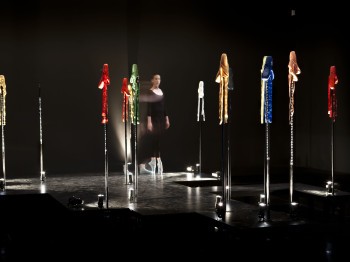
A woman performs on a stage surrounded by colored pointe shoes on poles.
Suzanne Bocanegra, Little Dot performance at the Tang Museum, 2010. Credit: Peter Serling.

Music/Tech: Suzanne Bocanegra

Suzanne Bocanegra’s performance piece-cum-film, “When a Priest Married a Witch,” is a kind of creative origin story, the portrait of the artist as a young woman. She writes on her website it is “part artist’s talk, part performance, part cultural history, part sound installation.” Showing a rough cut of the film, Bocanegra kicked off CAST’s Spring Sound series as the first in a series of lecture/demonstrations by prominent sound and multimedia artists. Part of the MIT course, Music and Technology, the lecture/demonstrations are open to both students and the general public alike.